
The Dual-Speed Supply Chain: How Oil and Gas Procurement Can Adapt to a Tariff-Driven World

From commodity pipes to AI-enabled drilling controls, oil and gas equipment supply chains are being rearchitected around resilience. Smaller operators can’t afford to be left behind.
Crude oil, gasoline, and other refined products may be “deliberately shielded” from the Trump administration’s recent tariffs. But the parts and equipment necessary to keep these resources flowing—from pipes and turbines to artificial lift and autonomous drilling systems—remain unprotected, catalyzing a dramatic transformation in O&G companies’ global supply chains.
Gas turbine prices are up nearly 200 percent since 2019 as trade-related supply chain bottlenecks have collided with data center-driven demand, an increasingly concentrated original equipment manufacturer base, and constrained manufacturing capacity. These bottlenecks cut across sectors, creating extensive delays for critical equipment servicing multiple industrial areas—lead times for gas turbines alone now exceed four years—and can have a domino effect, with deliveries for projects approved today unable to arrive until 2030 or later. Meanwhile, tariffs on steel, aluminum, and copper could increase material and services costs by up to 40 percent.
Supply chains for certain equipment may continue to be reengineered around competitive prices. However, O&G purchasers will increasingly factor in operational resilience and geopolitical alignment rather than cost alone, particularly as sanctions and trade policies intensify and countries make energy security a matter of national sovereignty.
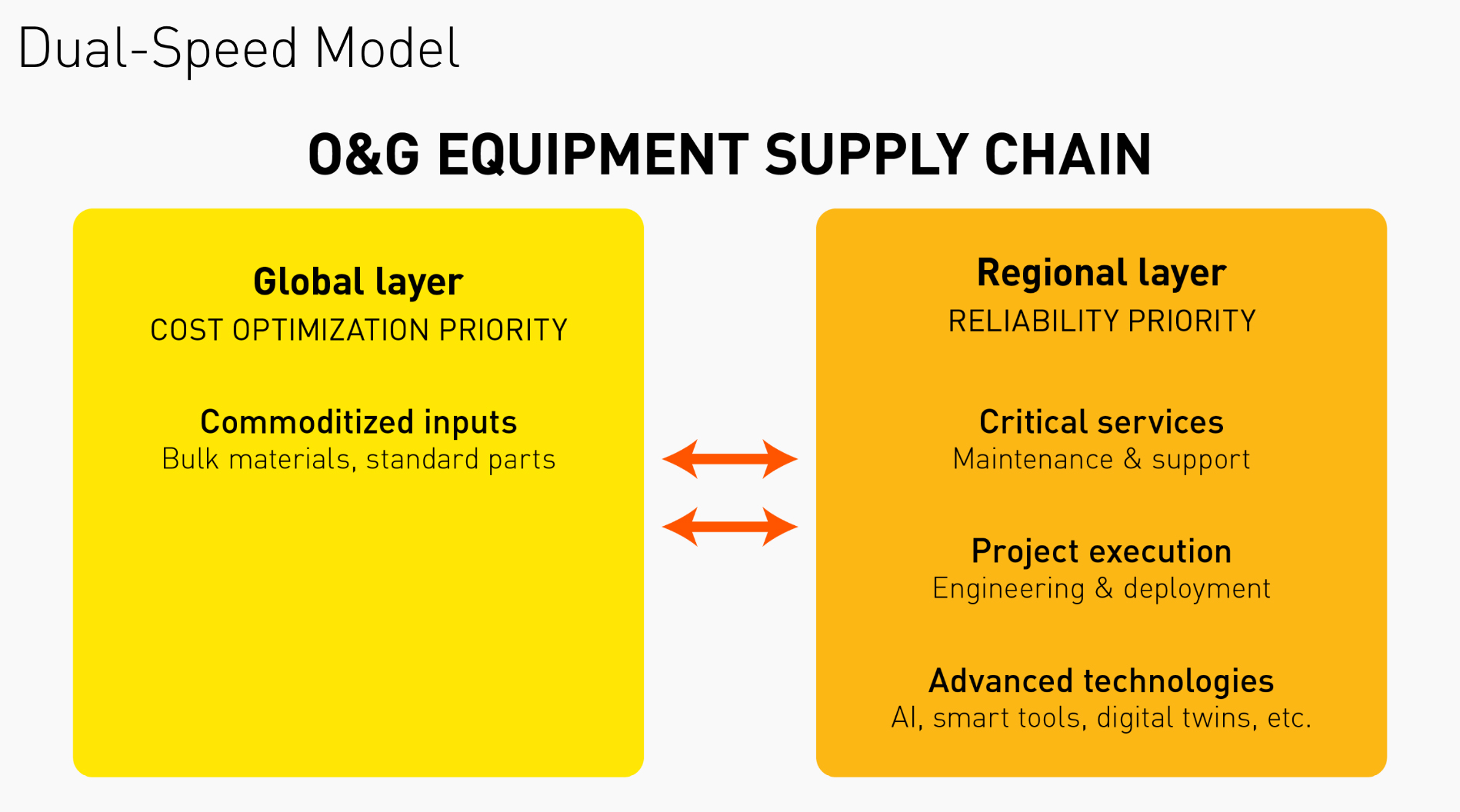
The industry is quickly heading toward a dual-speed supply chain model that pairs a global, cost-optimized layer for commoditized inputs with a regional, reliability-focused layer for critical services, project execution, and sensitive technologies. Major players have already begun to optimize their supply chains in this regard; smaller operators would do well to follow suit.
O&G executives should think about where the products their equipment supply chains depend on fall in this new model—and what that will mean for their procurement strategies in the years to come.
Where Do O&G Solutions Fit in a Dual-Speed Supply Chain Model?
Supply chain dynamics differ significantly depending on the complexity of a given output. Sourcing for commodity products like standard pipes and tubular grades is still largely cost dependent. But reliability is king for sophisticated technologies (e.g., directional drilling technology, automated rigs), which are largely driven by European and American intellectual property and require specialized engineering and equipment.
Take a country like Brazil: it has one of the most advanced deepwater O&G operations in the world, operating far offshore with high quality and environmental standards. A single equipment failure would carry enormous costs. Consequently, operators typically align with top (Western) vendors rather than the cheapest option.
Geopolitical alignment and geographic convenience also factor into purchasing decisions but can be subject to significant fluctuations. While the Middle East conflict hasn’t dented equipment supply chains much (the industry doesn’t source heavily from that region), a China-Taiwan conflict would present a bigger risk scenario because a significant volume of O&G components comes from Taiwan, China, and other countries in the region. Any disruption would affect product sourcing and marine shipping routes, with impacts on the latter creating negative effects on costs, timing, and cargo security.
The more complex the product, the more O&G companies will look to high-quality, localized, and geopolitically aligned supply chains. Consider the following breakdown:
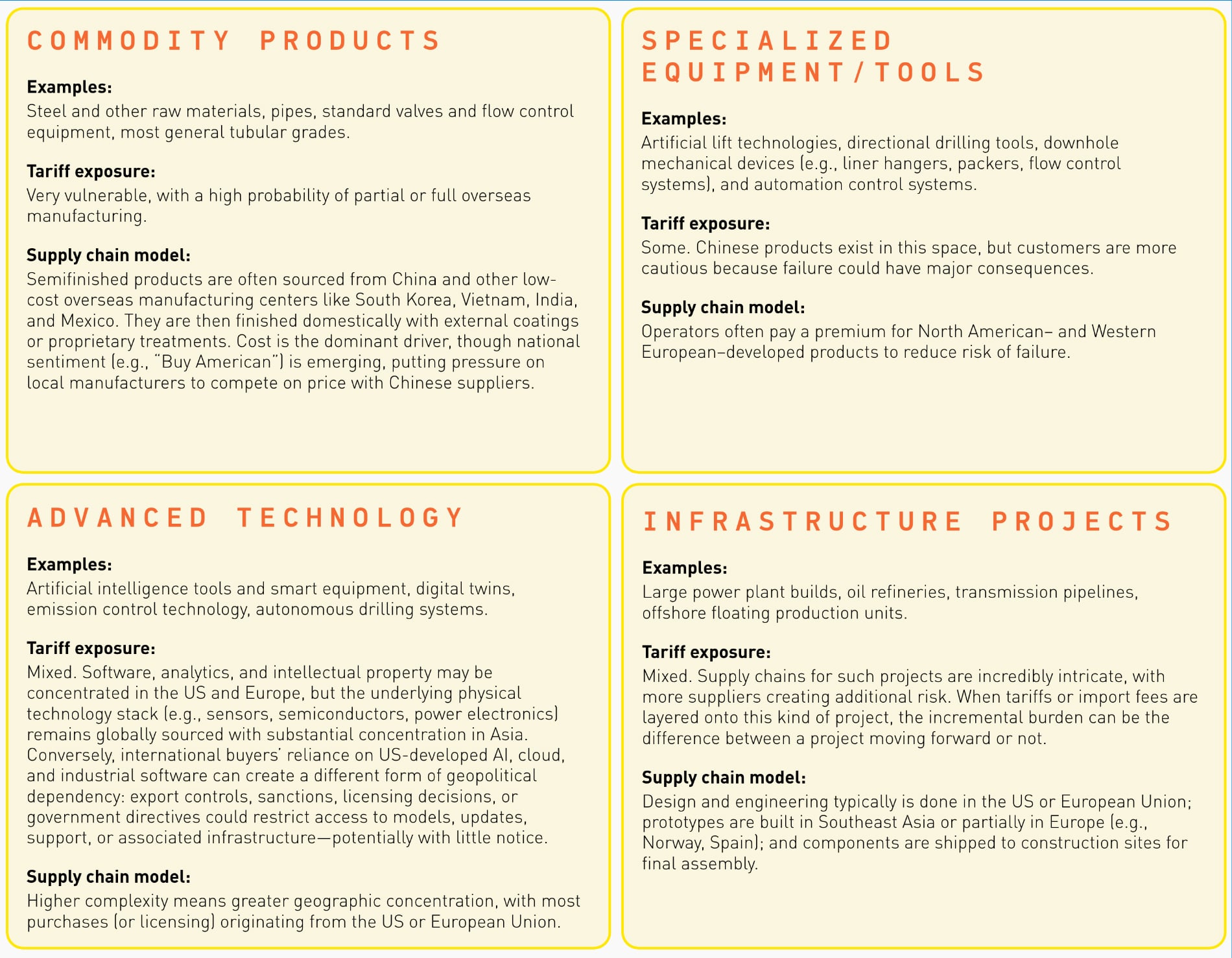
- Commodity products
- Examples: Steel and other raw materials, pipes, standard valves and flow control equipment, most general tubular grades.
- Tariff exposure: Very vulnerable, with a high probability of partial or full overseas manufacturing.
- Supply chain model: Semifinished products are often sourced from China and other low-cost overseas manufacturing centers like South Korea, Vietnam, India, and Mexico. They are then finished domestically with external coatings or proprietary treatments. Cost is the dominant driver, though national sentiment (e.g., “Buy American”) is emerging, putting pressure on local manufacturers to compete on price with Chinese suppliers.
- Specialized equipment/tools
- Examples: Artificial lift technologies, directional drilling tools, downhole mechanical devices (e.g., liner hangers, packers, flow control systems), and automation control systems.
- Tariff exposure: Some. Chinese products exist in this space, but customers are more cautious because failure could have major consequences.
- Supply chain model: Operators often pay a premium for North American– and Western European–developed products to reduce risk of failure.
- Advanced technology
- Examples: Artificial intelligence tools and smart equipment, digital twins, emission control technology, autonomous drilling systems.
- Tariff exposure: Mixed. Software, analytics, and intellectual property may be concentrated in the US and Europe, but the underlying physical technology stack (e.g., sensors, semiconductors, power electronics) remains globally sourced with substantial concentration in Asia. Conversely, international buyers’ reliance on US-developed AI, cloud, and industrial software can create a different form of geopolitical dependency: export controls, sanctions, licensing decisions, or government directives could restrict access to models, updates, support, or associated infrastructure—potentially with little notice.
- Supply chain model: Higher complexity means greater geographic concentration, with most purchases (or licensing) originating from the US or European Union.
- Infrastructure projects
- Examples: Large power plant builds, oil refineries, transmission pipelines, offshore floating production units.
- Tariff exposure: Mixed. Supply chains for such projects are incredibly intricate, with more suppliers creating additional risk. When tariffs or import fees are layered onto this kind of project, the incremental burden can be the difference between a project moving forward or not.
- Supply chain model: Design and engineering typically is done in the US or European Union; prototypes are built in Southeast Asia or partially in Europe (e.g., Norway, Spain); and components are shipped to construction sites for final assembly.
Smaller, Regional Operators Must Evolve or Risk Falling Behind
Major energy companies, which tend to be aligned with premier suppliers around the world, are more immune to these shifting supply chain dynamics, even as the complexity of their vast footprints turns tariff, trade, and geopolitical issues into a constant headache.
They must identify cost-optimization strategies. For instance, an offshore activity surge between 2007 and 2010 saw a limited number of manufacturers of specialized subsea equipment. Delivery delays became a serious problem. In response, large global operators began signing long-term supply agreements for standardized equipment that could be deployed across any of their global assets.
Unfortunately, smaller (largely US-based) regional operators may not have the muscle and reach to implement sophisticated procurement strategies like this. Instead, they tend to prioritize cost control (e.g., via Chinese products) and accept some performance trade-off. As a result, they’re more exposed to tariff impacts and should aim to adopt some form of the dual-speed model to stay ahead of the curve. That can be challenging: smaller companies often buy the cheapest option because they lack long-term budget visibility, even when the economics favor higher-quality purchases. This is why the largest operators factor total cost of ownership into every procurement decision.
Non-US companies—particularly national oil companies in the Middle East, Africa, and Latin America—bring their own dynamics to the table. While they may depend on US-based sources due to technology ownership, high-end manufacturing capabilities, and/or supplier locations, they are significantly less exposed to tariff and geopolitical disruptions than pure US players.
Ultimately, the combined impact of new trade policies, sanctions, industrial strategies, supply-demand imbalances, and energy security priorities are not “deglobalizing” the O&G equipment supply chain. Rather, they are reglobalizing around trust, access, and resilience, with supply chains increasingly defined by who you can depend on—not just where you can source most cheaply.
Procurement leaders must address the implication to segment sourcing strategies based on operational criticality, the availability of qualified substitutes, and the time required to switch suppliers. The broader objective should be to strengthen supply-chain resilience by preserving qualified optionality through multiple approved suppliers, interchangeable specifications, and commercial arrangements that secure access to constrained capacity.