Are You Sure You Know Your Suppliers?

As global customs enforcement intensifies, executives must strengthen supply chain due diligence to avoid civil and criminal liability.
The Sourcing Blindspot: The Illusion of Distance
Global supply chain diversification has hit an “all-time high,” as one 2026 report shows, with multinational manufacturers seeking economic resilience amid ongoing trade wars, fast-changing tariff regimes, and volatile geopolitical conflicts.
But more diversification does not equate to less risk. “Friendshoring” efforts to move final assembly and primary sourcing out of high-tariff jurisdictions like China to preferred trading partners such as Vietnam, India, or Mexico have made supply chains longer, more complicated, and significantly more opaque.
Whether or not this push has actually bolstered resilience, it has exposed a major operational vulnerability, which we will call tier-1 complacency: just because your direct contract manufacturer is in a friendly nation does not mean the entire supply chain is inherently clean. As margins tighten and tariff rates change on a seemingly daily basis, internal teams and customs brokers can be lulled into an almost pathological incuriosity about their suppliers’ suppliers and potentially illicit activity.
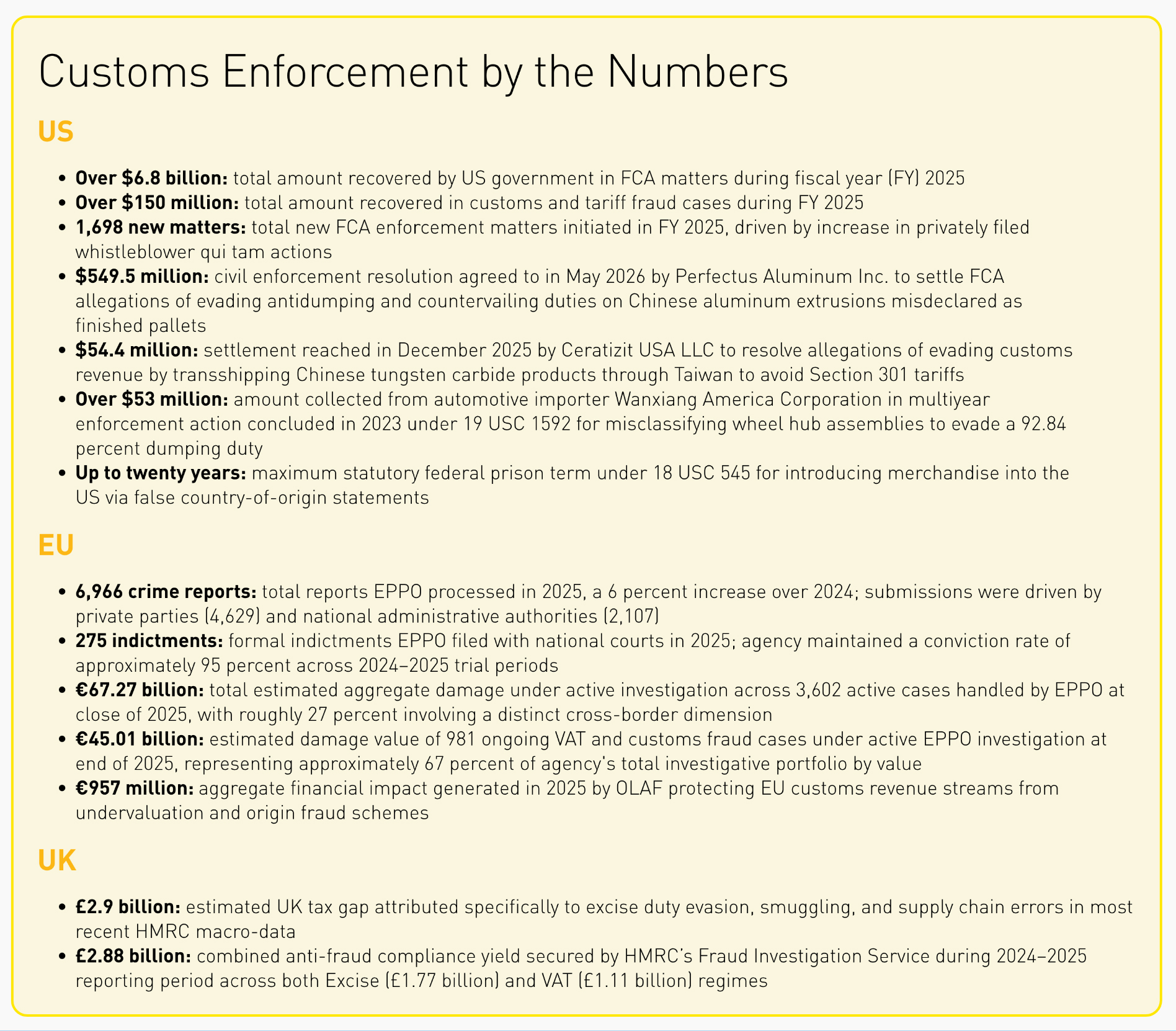
This creates a danger for importers and manufacturers since the regulatory frameworks and tools designed to police ever-growing corporate supply chains have expanded alongside them. Increasingly well-staffed, funded, and networked agencies have intensified their focus on transshipment, origin fraud, undervaluation, and misclassification (see “Customs Enforcement by the Numbers”).
For executives, the primary detection risks at customs are no longer just a logistical nuisance, added paperwork, or minor delays at the port. If a sub-tier supplier cuts corners and your internal team accepts that, your business may absorb a catastrophic regulatory shock—or even land managers behind bars.
The New Customs Enforcement Ecosystem: Where Mounting Political Resolve, Expanded White-Collar Accountability, and Technical Sophistication Meet
The times of spot-checks at the container terminal have passed. Across the United States, European Union, and United Kingdom, a new customs enforcement ecosystem draws a direct line between global supply chains and local white-collar culpability. Three interconnected shifts define this ecosystem:
- Rising political pressures on governments and regulatory bodies: Dogmatic protectionism, a heightened focus on domestic economic resilience, and national budget constraints have elevated customs enforcement from a back-office audit exercise to a matter of economic sovereignty and national security.
- Seismic shifts in legal frameworks and expanded accountability: The statutory frameworks governing international commerce have undergone a fundamental mutation. Customs blunders historically categorized as technical administrative oversights or simple post-clearance civil debt can now throw manufacturers into severe corporate, civil, and even criminal jeopardy.
- Increasingly sophisticated detection technologies: The chances of detection have increased considerably. Today’s detection risk emanates from a trifecta of hyper-incentivized whistleblower networks, algorithmic state oversight, and data integration across agencies.
Key Customs Enforcement Developments in the US, EU, and UK
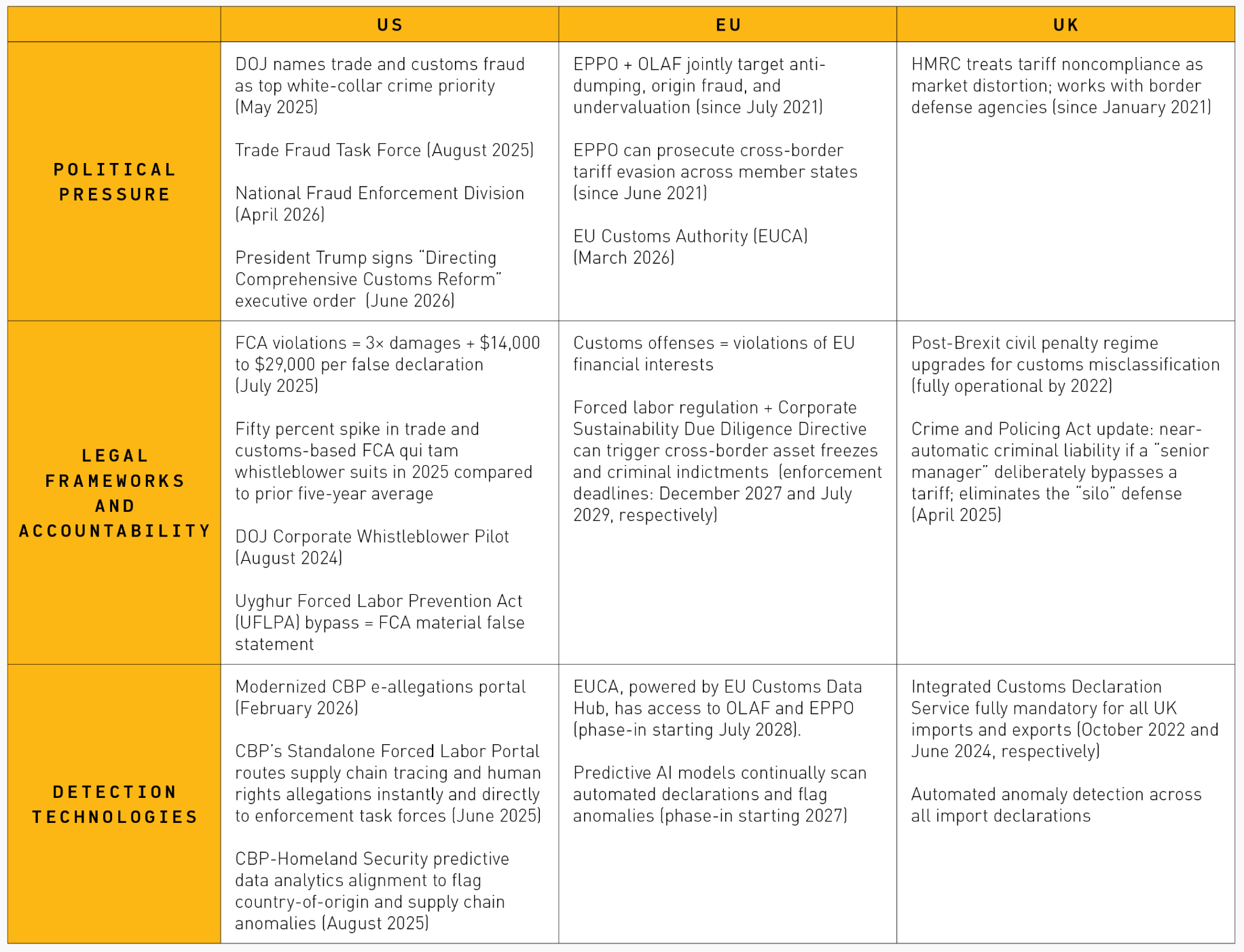
A high-level overview of recent developments across critical jurisdictions follows (see Table 1 for a comprehensive list of policy updates):
In the US, detecting customs fraud and tariff evasion is prioritized, decentralized, and heavily incentivized.
In 2025, the Department of Justice (DOJ) issued a directive designating “trade and customs fraud, including tariff evasion” as a white-collar crime priority and created a Market, Government, and Consumer Fraud unit—composed of veteran Foreign Corrupt Practices Act advisors—to address it. Just this June, a new executive order ratcheted up the pressure even further, directing US Customs and Border Protection (CBP) and the Department of Homeland Security to overhaul import regulations and increase enforcement of existing customs laws. At the same time, failure to pay mandatory customs duties now carries automatic False Claims Act (FCA) exposure.
Hyper-incentivized whistleblower networks compound these risks. Heightened use of the FCA’s qui tam provision empowers any corporate insider, logistics clerk, or direct market competitor to sue an importer on behalf of the government for transshipment, origin fraud, undervaluation, misclassification, or any other form of tariff evasion. In addition to this civil mechanism, the DOJ’s new criminal-enforcement Corporate Whistleblower Awards Pilot Program turns a company’s own internal documentation into a legal gauntlet, with whistleblowers eligible to claim up to 30 percent of the government’s initial financial recovery.
Advanced technology and data sharing further facilitate enforcement efforts: CBP’s e-Allegations program allows competitors to submit detailed supply-chain discrepancies anonymously. In parallel, the US launched the interagency Trade Fraud Task Force last August to break down government information silos and increase interagency data exchange. The intent is to scale cross-agency data tracking to identify inconsistencies in documentation across agencies to detect potential false statements that are indicative of tariff evasion and transshipment anomalies.
In the European Union, harmonized enforcement and algorithmic oversight raise the bar.
The EU now treats customs offenses as violations of the bloc’s financial interests, enabling the European Public Prosecutor’s Office (EPPO) to prosecute cross-border tariff evasion schemes across participating member states with an increasingly harmonized matrix of national criminal penalties.
Lawmakers also escalated the joint operational focus of the EPPO and European Anti-Fraud Office (OLAF) to target anti-dumping circumvention, origin fraud, and systemic undervaluation. Transferring OLAF’s evidence directly to its rapid criminal prosecution track allows EPPO to bypass the sluggish, multiyear civil debt collection frameworks traditionally handled by national courts.
Artificial intelligence (AI) has also entered the picture. Driven by the landmark 2026 Union customs code reform, the newly formed EU Customs Authority (EUCA) will centralize vital customs operations powered by the EU Customs Data Hub—a singular digital interface replacing twenty-seven separate national information technology systems. Using predictive AI models, the bloc’s unified customs systems will scan automated declarations continuously across major maritime hubs. If a shipment’s declared value or routing logic deviates from historical macro-data, the cargo will automatically flag for an exhaustive post-clearance audit or criminal seizure.
Crucially, because the Data Hub grants direct, real-time access to EPPO and OLAF, a red flag in the system instantly converts administrative anomalies into cross-border white-collar criminal targets.
In a post-Brexit UK, tariff noncompliance is a matter of economic sovereignty—with corporate penalties to match.
Under pressure to safeguard domestic markets post-Brexit, His Majesty’s Revenue & Customs (HMRC) now treats tariff noncompliance as a critical market distortion, working closely with border defense agencies to police geopolitical trade lines.
Authorities have also reengineered corporate accountability: under the Crime and Policing Act, companies will face near-automatic criminal liability if a senior manager deliberately bypasses a tariff or origin rule to protect margins. This effectively eliminates the traditional silo defense that the boardroom was unaware of the practice, thereby establishing a clear legal expectation for active supply chain auditing.
What’s more, the HMRC has aggressively closed the visibility gap through its fully integrated Customs Declaration Service, which serves as an automated anomaly-detector that can expose UK importers to strict enforcement actions.
Table 1. A New Trade and Customs Enforcement Ecosystem: Recent Policy Initiatives in the US, EU, and UK
Five Supply Chain Due Diligence Best Practices to Reduce Customs Fraud Risk
Long, complex, and opaque supply chains do not just obscure tracking—they create incentives for regional managers, local procurement teams, or compliance staff to cut corners to protect profit margins and hit strict cost targets.
Those vulnerabilities can easily turn into liabilities. Protecting a corporation from modern enforcement requires a framework that does not merely react to external audits but actively prevents internal misconduct.
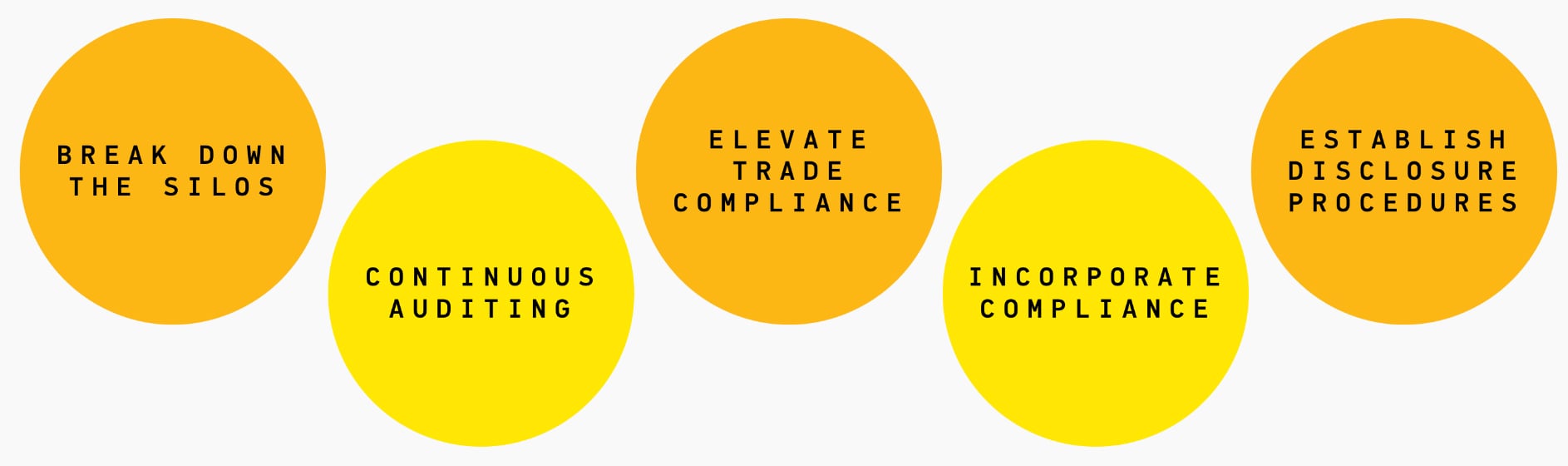
Here are five best practices to get started:
- Break down the silos: Trade compliance must be integrated directly into procurement decisions, vendor onboarding, and enterprise resource platforms. Procurement must be evaluated on regulatory alignment, not just unit cost.
- Continuous auditing: Implement automated “sanity checks” on tariff codes, unit values, and country-of-origin data to match the algorithmic scrutiny of customs authorities. For example, if a tier-1 vendor’s pricing exhibits anomalies compared to raw material indices, flag it internally before an agency algorithm flags it for you.
- Elevate trade compliance: Transition trade compliance from an administrative cost center to a core governance function positioned adjacent to the C-suite. Reporting directly to the general counsel or chief risk officer removes compliance from the structural conflicts of interest inherent in procurement and logistics silos, where margin pressures can incentivize regulatory shortcuts. This alignment also secures independent supply-chain verification and real-time tracking, shielding the balance sheet from dangerous liabilities.
- Incorporate compliance into supplier partnerships: Treat compliance as a key metric in supplier relationship management. The most resilient suppliers are willing to provide absolute transparency into their own sub-tier raw material sourcing. Make independent data verification a non-negotiable term of contract renewals.
- Establish disclosure procedures: If an internal audit or whistleblower report reveals a customs or tariff compliance issue, corporate legal teams must assess—carefully and immediately—whether disclosure is required or appropriate under privileged corporate self-disclosure frameworks. Using these avenues early can determine the difference between an administratively mitigated settlement and a corporate criminal indictment.
The Next Generation of Global Supply Chains Is Here
Redesigning global supply chains for the future is a remarkable achievement. But a chain is only as secure as its most obscured link, and an opaque network could breed potentially catastrophic compliance failures.
Asking “Are you sure you know your suppliers?” is now the foundational prerequisite to protect your organization, your executives, and your business from internal misconduct and systemic legal exposure.