
The Verification Economy, Explained: How to Assess AI-Generated Work, Evidence, and Claims

BRG experts explain what the verification economy means for general counsel, boards, and executives and how organizations can prove what they claim.
The plan was simple, at least in theory. An organization deployed an artificial intelligence (AI) agent to draft responses to technically complex customer support tickets, aiming to cut in half the time staff spent on each ticket.
Yet six months later, handling time had gone up, not down.
It was not that the AI was bad at the job; its responses were about 90 percent accurate. But errors in the other 10 percent could cause customers to lose data, and no one could tell in advance which responses were wrong. Employees had to read and verify every line the AI wrote, as highlighted by BRG’s Jason Gu.
AI has made claims of all kinds (e.g., support response, legal brief, valuation, payslip) cheaper to produce but not cheaper to verify. A database tracking AI hallucinations in court filings counted more than 2,000 instances worldwide as of September 2026, up from about 200 in mid-2025. Finance teams now spend a quarter of their week fact-checking AI. Fraudsters have taken notice too: in February 2026, Commonwealth Bank of Australia reported roughly A$1 billion in suspected home loan fraud, much of it supported by AI-generated documents.
Drawing on BRG experts featured in this issue of ThinkSet, this guide explains what the verification economy is, where it creates risk, and how organizations can prove what they claim.
What Is the Verification Economy?
The verification economy refers to the growing value of being able to prove that AI-generated information is authentic, accurate, and reliable. In this new world, trust shifts away from whoever can produce the most persuasive content toward those who can show where it came from, how it was checked, and who stands behind it.
For most of business history, producing evidence was expensive while checking it was comparatively cheap. Generative AI has reversed that ratio.

Why Does AI Make Verification Harder?
AI lowers the cost of producing convincing content without lowering the cost of checking it. Three forces drive the gap:
- Fabrications pass controls. In a 2024 alert on deepfake fraud, the US Financial Crimes Enforcement Network (FinCEN) found that financial institutions often detected synthetic content in identity documents only after they had passed through onboarding controls.
- Review eats the savings. When AI produces a number (e.g., a discount rate), a reviewer who doubts it must work backward through a black box, which can take longer than building the number from scratch.
- The record gets elusive. With AI, the prompt is the closest thing to a system log. But AI outputs vary, and some AI providers now offer zero data retention, so the prompt may not exist when investigators need it.
Where Does the Verification Gap Create Risk?
Wherever a consequential decision rests on information that AI can fabricate, alter, or produce without a traceable record, the verification gap creates risk. BRG experts highlight five key areas where this risk appears:
1. Financial services: AI-enabled fraud
Onboarding, lending, and payments run on documents and instructions supplied by outsiders, which makes banks prime targets for synthetic identities and impersonated payment instructions. Yet fewer than 40 percent of senior internal audit leaders in North America say their functions are adequately prepared to detect AI-enabled fraud. Bad data accepted at onboarding can flow into credit loss estimates and disclosures, so AI-enabled fraud is also a financial reporting issue for audit committees.
2. Disputes and investigations: AI records as evidence
Whether an organization can reconstruct AI-related misconduct depends largely on a decision made long before any dispute: whether to license (rent) a frontier AI model or build (own) one. Renting cedes control of data access and retention to the AI provider. Owning provides control but makes the organization accountable for every design and training choice. General counsel should help make the call.
3. Privacy litigation: proving consumer consent
A recorded click shows what happened on screen, not what a consumer noticed, understood, or intended. In Calhoun v. Google, a federal court denied class certification after finding that millions of proposed class members may have seen and consented to different disclosures. BRG consumer behavior experts verify consent by testing four stages separately: exposure, attention, comprehension, and choice.
4. Valuation: defending AI-assisted numbers
AI is changing how valuations are built. A model can list every input that moved between two valuation dates without explaining the context that drove the change. That gap matters most in recurring fair-value reporting for private funds, which the US Securities and Exchange Commission’s fiscal year 2026 examination priorities keep among core review areas.
5. Healthcare: proving AI is working
In 2025, 27 percent of health systems paid for commercial AI licenses, triple the rate across the US economy. Demonstrating return on investment on that spending requires measuring the right outcomes. For example, ambient AI scribes raised visit volume just 1.7 percent in a 2026 study across five major health systems, while separate research found that one month of use cut clinician burnout by roughly 13 percentage points. Health systems can give AI a fair test before deciding whether to scale or cut it.
What Does the Verification Economy Mean for General Counsel and Executives?
Using AI does not transfer responsibility to AI.
Professional duties, fiduciary obligations, and disclosure requirements stay with the people who rely on AI output. What changes is how much an organization must be able to show. Courts are sanctioning filings with AI-hallucinated citations, the SEC is checking whether advisers’ AI use matches their controls and investor disclosures, and language on AI use now appears routinely in professional engagement letters.
Each member of the leadership team faces a version of the same question:
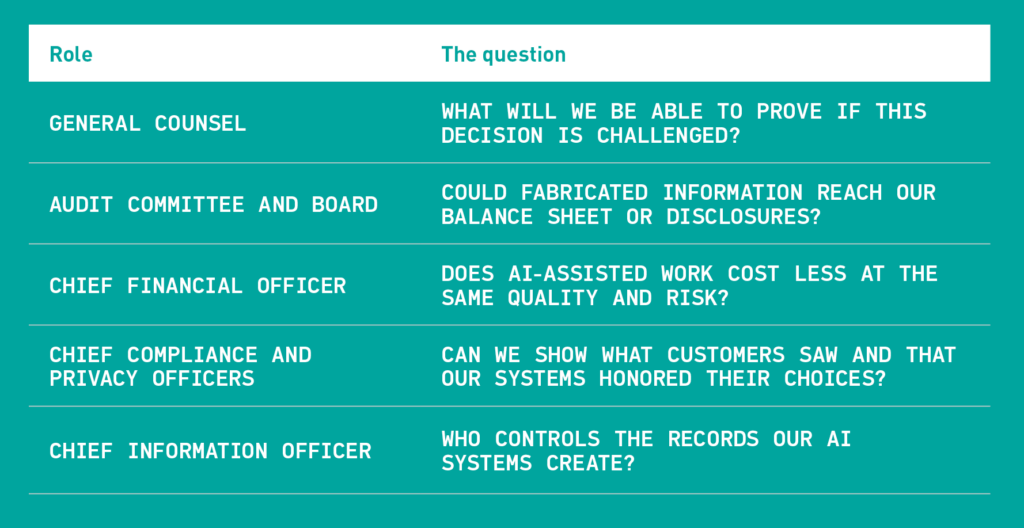
How Can Organizations Prove What They Claim?
Organizations should build verification into processes before it is needed, rather than reconstruct evidence after a dispute begins. BRG experts highlight five practices.
- Give legal a say in AI decisions. The AI models that an organization licenses or builds—and on what terms they do so—determine which records will be reviewable later.
- Build the record as you go. Set a defensible retention policy for AI prompts and logs and confirm it is operating. Preserve design documentation, screen flows, and consent logs.
- Verify independently of the source. For example, callbacks on a suspicious payment instruction should use contact details the institution already holds, not those supplied in the request.
- Agree on “good enough” in advance. BRG’s Gu calls this “clearing”: work that passes agreed checks may be used for a stated purpose without full re-review, under rules that settle in advance who bears the loss when an error gets through.
- Set decision gates and assign an owner. Instead of judging AI on one budget cycle, track each tool through set checkpoints, with a team accountable for deciding whether to scale, fix, or retire it.
Proof Is the New Premium
No organization can verify everything. The verification economy doesn’t demand that it try.
Credit card networks never proved that every purchase was legitimate before approving it. They agreed in advance when a transaction was good enough to proceed and who would bear the loss if it wasn’t.
Organizations that apply the same discipline to AI-era evidence can build trust that will hold up before auditors, regulators, and courts.
Frequently Asked Questions About the Verification Economy
What is the verification economy?
The verification economy refers to the rising value of proving that information is authentic, accurate, and reliable as generative AI makes content, data, and analysis cheap to produce but hard to validate. Organizations that can show where information came from, how it was checked, and who stands behind it gain an advantage with regulators, courts, investors, and customers.
Why is AI-generated content hard to verify?
AI-generated content looks plausible but is produced at high volume and often lacks a traceable record. AI outputs are nondeterministic, so the same prompt can yield different results, and some AI providers retain prompts briefly or not at all. Reviewers often must work backward through a model’s logic, which can take longer than doing the work manually.
How are fraudsters using AI against financial institutions?
Fraudsters use generative AI to create synthetic identities, fabricated identity documents, falsified borrower financial statements and income records, and impersonated voice and video payment instructions. These fabrications can pass through onboarding, lending, and payment controls. The resulting bad data can flow into credit loss estimates and financial reporting.
Who is liable when AI-generated work turns out to be wrong?
Using AI does not remove professional or legal responsibility from the people and organizations that rely on it. Parties should agree in advance who will investigate, fix, and bear losses for four types of failure: bad inputs, failed controls, residual error, and misuse of work beyond its approved purpose.
How long should companies retain AI prompts and logs?
No settled standard exists for retaining AI prompts. Outside AI, a ninety-day retention period for system logs has long been common, but frontier AI providers now offer zero data retention. Organizations should set a consistent, defensible retention policy, confirm it is operating, and recognize that renting an AI model may leave retention in the provider’s hands.
Does a click prove that a consumer consented?
A click proves only that an action occurred on screen, not that the consumer noticed, understood, or intended to consent. In digital privacy litigation, BRG consumer behavior experts test consent across four stages (exposure, attention, comprehension, and choice) using business records, product evidence, and research designed for litigation.
How can organizations prove AI delivers a return on investment?
Organizations should set a baseline before rollout and measure the right outcomes. In healthcare, ambient AI scribes have been associated with only modest gains in visit volume but lower self-reported clinician burnout. Organizations should inventory existing AI, stage rollouts to allow comparisons, and assign an owner to review each tool at set decision points: scale, fix, or retire.
What should audit committees ask about AI-enabled fraud?
Where could unreliable information cause significant losses? Do verification controls rely on evidence supplied by the requester? Do key financial reporting inputs have a traceable history? How would management find related exposures after a fabrication is discovered? Do internal and external audit cover these risks?