When the Chips Are Down: High-Purity Quartz and the Hidden Geography of Semiconductor Leverage


BRG is home to renowned thought leaders and experts considered authorities in their fields of work. Our timely research and perspectives provide analysis and insights on the most important issues facing the industries and organizations we serve.
China’s rare-earth leverage dominates the US–PRC economic competition debate. But semiconductor manufacturing also depends on obscure process materials, including high-purity quartz from North Carolina that sits inside US and ally-controlled value chains.
China’s dominance in rare earths[1] has become a central anxiety of the US–China great-power competition. The concern is justified. Rare-earth elements and the magnets made from them are embedded in defense systems, electric vehicles, wind turbines, robotics, aerospace, telecommunications, and advanced electronics. China does not just mine many of these materials; it controls much of the processing, separation, refining, and magnet manufacturing capacity that turns raw material into industrial leverage.
That gives Beijing real power.
Recent export restrictions show that China increasingly is willing to use critical minerals as tools of economic statecraft. The Center for Strategic and International Studies (CSIS) reported that China’s April 2025 restrictions on heavy rare earths and permanent magnets caused rapid disruption across allied defense and industrial supply chains.[2] Reuters reported in May 2026 that China effectively had cut Japan off from heavy rare-earth elements and related materials, including dysprosium, terbium, and yttrium oxide, as well as gallium—all materials relevant to advanced electronics and defense production.[3]
Those facts justify concern about China’s leverage. They do not justify a conclusion that Beijing controls the whole semiconductor stack. While China’s position is powerful in several upstream inputs, China does not control the tools, process materials, software, optical systems, qualified suppliers, or human knowledge that make advanced semiconductor manufacturing possible.
The semiconductor supply chain is not a single line from mine to chip. It involves a stack of chokepoints that includes minerals, gases, chemicals, quartz, wafer substrates, lithography tools, design software, photomasks, deposition and etching equipment, metrology systems, packaging technology, precision optics, maintenance networks, tacit process knowledge, trusted suppliers, and cleared or reliable human talent.
China dominates some layers of that stack. The United States and its allies dominate others. The contest turns on stacked constraints: how pressure in one layer interacts with dependence in another. The balance of leverage therefore is more complicated than the rare-earth debate suggests.
For companies, the practical issue is not which government has the stronger hand in the abstract. It is whether management knows which layer of its value chain can fail first, which layer has no qualified substitute, and which dependencies sit outside ordinary supplier-risk dashboards. High-purity quartz (HPQ) matters because it is a process material embedded in wafer production, optical systems, and fabricated consumables. That is the kind of dependency that value chain risk management (VCRM) is meant to surface.
China’s leverage is real but bounded
China’s rare-earth position spans multiple stages of the value chain. Processing and refining matter more than mining. Rare earths are not useful to a defense contractor or electronics manufacturer simply because they exist in the ground. They must be separated, purified, alloyed, magnetized, qualified, and integrated into components.
That is where China’s position becomes strategically important. Beijing’s influence over heavy rare-earth elements, rare-earth magnets, gallium, graphite, germanium, and other critical inputs can create delays, cost pressure, and substitution problems across allied industrial bases.
For high-priority defense systems, the United States is unlikely to rely entirely on just-in-time access to Chinese-controlled materials. The US has a formal National Defense Stockpile (NDS) managed through the Defense Logistics Agency (DLA), and DLA has publicly described expanded strategic materials programs involving rare earth elements and other defense-relevant materials. Public defense-sector reporting also has noted that the NDS includes multiple rare-earth elements along with materials such as copper, nickel, lithium, and antimony.[4]
The exact quantities, locations, component-level inventories, and wartime assumptions are not, and likely should not be, fully public. The public record still supports the basic logic: if rare earths are essential to missiles, aircraft, submarines, radars, satellites, drones, and precision-guided munitions, the US defense establishment has every reason to stockpile key materials, pre-qualify alternatives, fund domestic and allied capacity, and maintain contingency plans for priority systems.
That narrows the claim but does not eliminate China’s leverage. China can create delay, price pressure, and procurement friction. The more difficult question is whether those effects would be immediate, decisive, and militarily crippling across priority systems.
The limits of visible coercion
China’s rare-earth advantage is powerful because it is upstream, concentrated, and visible. Beijing can signal that it can interrupt supply to defense, electronics, clean energy, automotive production, telecommunications, and advanced manufacturing.
Export controls can create immediate disruption, price spikes, procurement delays, and political pressure. They also identify the dependency being exploited. Once used, the chokepoint becomes harder to treat as an obscure procurement issue. It becomes a boardroom risk, congressional issue, defense-industrial policy problem, and budget item.
Each restriction gives the target more information about what to stockpile, substitute, recycle, friend-shore, reprocess, or source from allies. The first use of a chokepoint may shock the system. Repeated use teaches the system where it is exposed.
America’s quieter cards
China’s leverage is concentrated in upstream materials. The US and allied positions are more dispersed, reaching into the tools, services, rules, and expertise needed to turn those materials into advanced technologies.
Beijing can threaten access to certain materials. Washington and its allies can restrict access to the tools, software, standards, components, services, and process knowledge required to turn those materials into frontier technologies.
The most visible example is lithography. The Netherlands’ ASML remains central to advanced semiconductor production, and Dutch export-control decisions, often coordinated with the United States, have limited China’s access to the most advanced systems. Recent debate over further restrictions on ASML’s deep ultraviolet (DUV) immersion lithography systems shows both the reach and limits of allied leverage. Washington can press for tighter controls, but allied governments do not always move in lockstep.[5]
The same pattern extends across the semiconductor production system. The United States has strength in chip design software, semiconductor intellectual property, advanced computing architectures, and export-control policy. Japan remains a critical supplier of semiconductor materials, photoresists, specialty chemicals, wafers, and precision equipment. Taiwan and South Korea hold deep manufacturing know-how in advanced logic, memory, foundry operations, and high-volume yield learning. Europe contributes lithography, optics, industrial gases, metrology, and precision engineering.
What matters here—more than just commodity supply—is control over the tools, services, standards, supplier networks, and accumulated process knowledge China still needs to reach and sustain the technological frontier.
Those allied advantages usually are discussed through export controls, advanced tools, and frontier chips. HPQ points to a quieter category: process materials that rarely dominate policy debate but determine whether advanced manufacturing can run at the required purity, yield, and reliability levels.
The quartz counterweight
Modern silicon wafers begin with ultra-pure silicon, which is melted and grown into single-crystal ingots. The molten silicon sits inside a quartz crucible. That crucible must withstand extreme temperatures while contributing vanishingly low levels of contamination. If unwanted impurities enter the melt, the resulting crystal can be compromised.
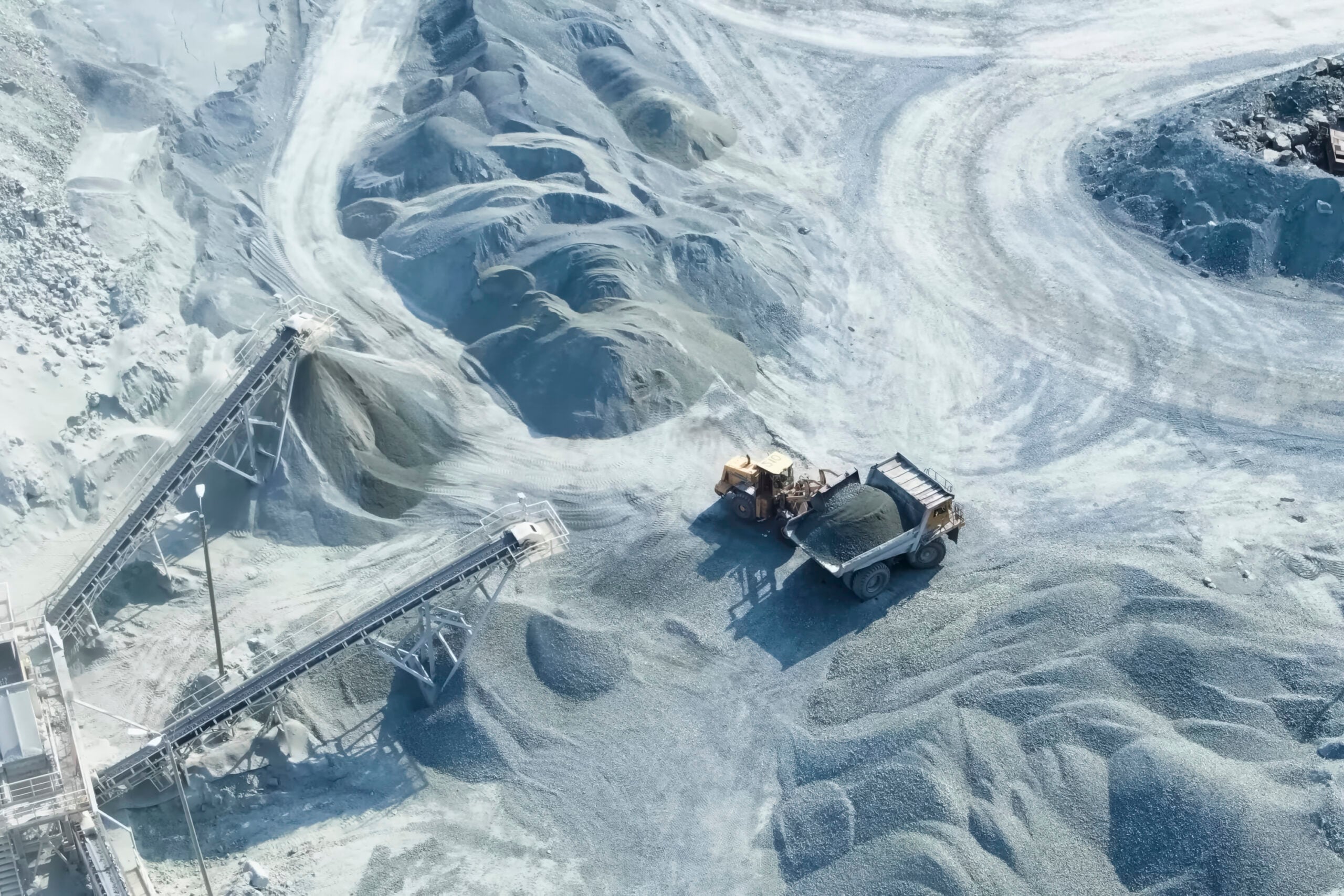
Spruce Pine, North Carolina, contains one of the world’s most important sources of high-purity quartz. Sibelco states that its IOTA high-purity quartz products are mined from two uniquely pure ore bodies at Spruce Pine and are used to produce fused quartz for high-tech applications including semiconductors, solar photovoltaic cells, optical fiber, and quartz lighting.[6]
Quartz is not America’s answer to the Chinese rare-earth mining and production problem. The comparison fails if it is treated as a simple material-for-material offset. Rare earths touch a broader set of defense and industrial systems, and China’s role in processing and magnet manufacturing is more directly weaponizable.
HPQ matters because it is a process dependency. It does not become the chip in any simple sense. It becomes part of the manufacturing environment that allows wafer production, fused quartz applications, optical fiber, quartz lighting, and other high-purity systems to operate within narrow contamination and thermal-stability tolerances. That makes it strategically relevant even though it is less politically visible than rare earths, gallium, graphite, lithium, or advanced artificial intelligence (AI) chips.
That distinction is central for VCRM. HPQ is the type of dependency that can sit below the level of ordinary supplier-risk reporting. A company may know its wafer supplier, equipment vendor, or component source without knowing whether a critical process material is concentrated in one geography, controlled by a small number of qualified suppliers, or dependent on purification and fabrication capacity that cannot be replaced quickly.
HPQ fits this quieter pattern. Spruce Pine is geographically located in the United States, but the relevant value chain runs through private operators, allied ownership structures, foreign customers, crucible makers, wafer producers, optical-material firms, and semiconductor manufacturers. Its strategic value does not come from a single government switch. It comes from the difficulty of replacing a qualified process material quickly once purity, consistency, customer qualification, and downstream manufacturing tolerances are considered.
The semiconductor contest is over stacked constraints
The US–China technology rivalry often is treated as a contest over whichever input is under stress at a given moment: rare earths, gallium, lithography tools, advanced chips, or fabrication capacity. The importance of those pressure points depends on where they sit in the production sequence. Semiconductor production depends on constrained inputs, specialized tools, qualified suppliers, permissions, process controls, and people with hard-to-replace knowledge. Control over one layer rarely settles the contest by itself.
That is the logic of stacked constraints. One country may control a critical material but still depend on foreign tools, software, maintenance networks, or process knowledge. Another country may control indispensable equipment but still be exposed to upstream materials, specialty chemicals, wafer inputs, or supplier concentration. The relevant capability exists only when enough layers line up at the same time.
China’s rare-earth position fits this framework. Heavy rare earths, rare-earth magnets, gallium, graphite, germanium, and related inputs give Beijing leverage over important upstream layers of the industrial base. But those inputs still have to move through other constrained layers before they become advanced weapons, communications systems, power electronics, or frontier semiconductors.
The same logic applies to US and allied chokepoints. HPQ, ASML tools, electronic design automation software, and advanced packaging each expose a different dependency. None is a complete answer to the others. Their significance comes from the fact that failure at one layer can slow or block the whole system.
For VCRM purposes, those layers fall into four categories: material and process-material constraints; tooling and production constraints; institutional constraints; and human and knowledge constraints.
Material and process-material constraints include rare earths, graphite, gallium, germanium, HPQ, helium, specialty gases, polysilicon, photomask substrates, photoresists, polishing materials, and ultra-pure chemicals. Tooling and production constraints include lithography, metrology, deposition, etching, wafer polishing, advanced packaging, process control, ultra-clean handling systems, spare parts, and equipment maintenance. Institutional and human constraints include export controls, trusted suppliers, qualified vendors, defense stockpiles, standards bodies, procurement rules, licensing regimes, allied coordination, process engineers, equipment specialists, materials scientists, cyber defenders, compliance officers, cleared personnel, supplier-qualification teams, and tacit know-how accumulated through years of manufacturing.
China’s rare-earth advantage is therefore serious but bounded. It gives Beijing leverage over one part of the stack while leaving it dependent on other layers that the United States and its allies still control or, at least, heavily influence.
This is where HPQ becomes useful as an analytical case. While it is not the largest chokepoint in the semiconductor stack, it is a clear example of how a process material can matter strategically because it sits at a point where purity, qualification, and production continuity intersect.
HPQ as a national-security watch item
High-purity quartz likely is already treated inside the US national-security community as a semiconductor-process material, not merely an industrial mineral. Spruce Pine availability is only one part of that risk picture. The more sensitive question is how China is trying to reduce dependence on Spruce Pine and allied quartz sources through domestic HPQ classification, synthetic quartz investment, quartzware manufacturing, crucible production, optical-material development, or overseas mineral exploration.
Chinese HPQ activity is both an intelligence problem and a supply-chain problem. Relevant indicators would include Chinese firms active in HPQ, fused quartz, synthetic quartz, crucibles, photomask substrates, optical fiber, and process quartzware, as well as Chinese-controlled mining projects where gold, pegmatite, silica, feldspar, or quartz-bearing systems may create HPQ optionality.
Gold exploration could provide a low-visibility pathway for quartz screening because gold systems often involve quartz veins or quartz-rich host rocks. The public record does not establish that Chinese firms are using gold projects for HPQ exploration. The hypothesis is testable through concession language, technical reports, sampling records, assay data, laboratory relationships, and links between mining firms and Chinese quartz-material companies.
For semiconductor companies, the same issue appears as supply assurance. HPQ-derived materials should be mapped as process dependencies: crucibles, quartzware, fused silica, photomask substrates, optical materials, and other consumables whose quality affects yield, throughput, and qualification. A supplier-risk program that stops at tier 1 will miss much of this exposure.
The human layer: insider threat as supply-chain risk
If the US-allied advantage is partly knowledge based, protecting chokepoints cannot mean guarding only mines, ports, fabs, and warehouses. It also requires protection for people, processes, and institutions throughout the semiconductor value chain.
Advanced manufacturing depends heavily on tacit knowledge. Some of the most valuable assets in the semiconductor ecosystem are not visible on a balance sheet: process recipes, yield-improvement practices, equipment servicing know-how, defect analysis, supplier qualification data, customer specifications, source code, mask data, metrology interpretation, and the accumulated judgment of engineers who understand why a process fails before the dashboard shows it.
Those assets can leak through cyber intrusion, espionage, employee compromise, careless contracting, supplier infiltration, joint ventures, talent recruitment, or commercial pressure. They can also degrade when experienced engineers retire, production moves without the associated tacit knowledge, or opaque supplier relationships replace trusted ones.
In this environment, insider threat is a supply-chain risk, not just a corporate security issue.
The same logic that applies to stockpiling rare earths applies to protecting knowledge nodes. A small group of engineers, supplier-qualification team, maintenance contractor, or software access point can become a chokepoint if too much operational knowledge or system access concentrates there.
Insider-threat programs, cyber hygiene, export-compliance systems, vendor screening, access controls, and trusted-workforce policies should be treated as part of industrial resilience.
The human layer is therefore part of the value chain and should be mapped, protected, and monitored with the same seriousness as critical materials, process tools, and qualified suppliers.
What VCRM requires
US and allied chokepoints are not a reason for complacency but instead to map dependencies more carefully and in greater detail.
If China has learned to identify and exploit allied dependencies, the United States and its partners need the same clarity about their own. The purpose should be resilience, not reckless retaliation.
That means identifying critical nodes that are too concentrated, too opaque, poorly defended, or difficult to replace quickly. HPQ is one example. Others include lithography components, photoresists, semiconductor-grade gases, ultra-pure chemicals, polishing materials, rare-earth magnets, gallium and germanium alternatives, wafer substrates, advanced packaging equipment, chip design software, maintenance networks, and the trusted personnel who operate them.
For companies, the VCRM discipline is practical: map process dependencies below tier 1; validate whether substitutes are technically qualified or merely commercially identified; monitor Chinese efforts to build, buy, or quietly explore for HPQ capacity; and protect the people, data, equipment access, and supplier relationships that carry tacit process knowledge.
Conclusion
China’s leverage is serious, especially in rare-earth processing, heavy rare earths, magnets, graphite, gallium, germanium, and other strategic materials. But the semiconductor economy rests on a wider set of dependencies, including lithography, design software, advanced tools, specialty chemicals, HPQ, trusted foundries, process knowledge, defense stockpiling systems, and human talent.
A quartz chokepoint is not the same as China’s rare-earth position, and treating it that way would overstate the case. The stronger conclusion is narrower: advanced manufacturing depends on less-visible industrial nodes, some of which sit inside US and allied value chains.
China does not hold all the cards. It just plays some of them more visibly.
[1] “Rare earths” generally refers to the seventeen rare earth elements: the fifteen lanthanides plus scandium and yttrium, which are commonly grouped with the lanthanides because they occur in similar deposits and share similar chemical properties. The term may refer to different forms depending on context, including rare-earth-bearing minerals or ores, separated rare-earth oxides, refined rare-earth metals, alloys, or finished components such as permanent magnets.
“Heavy rare-earth elements” generally refers to the higher-atomic-weight subset, commonly including europium through lutetium plus yttrium, while “light rare-earth elements” generally refers to lanthanum through samarium. Classification can vary by source and commercial usage.
[2] Center for Strategic and International Studies (CSIS), “Rare Earth Export Restrictions One Year Later.”
[3] Reuters, “China squeezes Japan over rare earths in repeat of 2010 showdown” (May 22, 2026).
[4] Defense Logistics Agency (DLA), “DLA R&D’s expanded Strategic Materials program helps reduce critical materials risks”; National Defense Magazine, “Critical Mineral Stockpiling Presents Opportunities” (March 6, 2026).
[5] Reuters, “US targets Chinese chipmaking with proposed export restrictions on ASML, others” (April 3, 2026).
[6] Sibelco is a global Belgian miner and producer of HPQ listed on the NASDAQ as SCR, operating out of Charlotte, North Carolina. Its website refers to its IOTA product line as high-purity quartz from Spruce Pine and used in a variety of applications across multiple industries.



Prepare for what's next.
ThinkSet magazine, a BRG publication, provides nuanced, multifaceted thinking and expert guidance that help today’s business leaders adopt a more strategic, long-term mindset to prepare for what’s next.