The IEEPA Tariff Refunds Series: What Importers Will Collect, and What They May Be Asked to Share

Executive Summary
Part I of this series addressed how the International Emergency Economic Powers Act (IEEPA) tariff refunds are administered. This second entry addresses whether refund payments will arrive, how much of the refund the company may be able to keep, and whether the company ultimately may owe some of the refunds to its customers or vendors.
- Most of the refund pool is already in motion. For older entries of non-plaintiffs, an October 8, 2026, class certification offers a path to recovery, but no refund order has yet been issued.
- The first individual filing deadlines fall on February 4 and April 5, 2027. The class ruling does not address these filers.
- Recovery from the government is capped. The recovery is limited to duty plus statutory interest.
- Customer claims may turn on the invoice. A separate tariff line item strengthens a customer or vendor’s claim, which may then exceed the refund.
Determining an Importer’s Refund Position
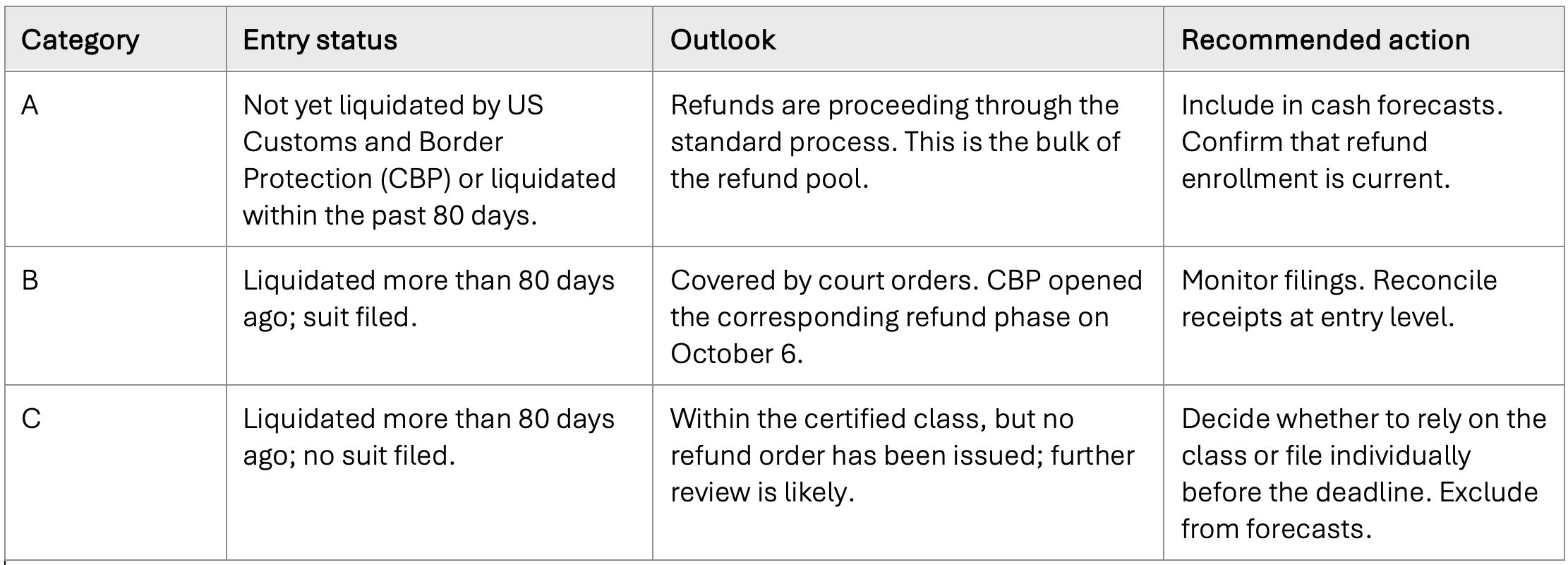
An importer’s expected recovery, timing, and required action depend first on the procedural status of each entry. The three categories below distinguish refunds already moving through the standard process from older entries that depend on litigation or further court action.
The Uncertainty for Category C
Category C is where recovery is at risk because CBP will not refund a non-plaintiff’s older entry without a court order.[i] Importers in more than 4,000 individual cases are covered; the question is whether others will be covered.
On October 8, the US Court of International Trade certified a class of all importers of record that paid International Emergency Economic Powers Act (IEEPA) duties between February 1, 2025, and February 19, 2026, other than those that filed their own actions.[ii] Membership is mandatory with no opt-out. The court expects refunds on all entries but has not yet ordered relief. The government, which contends that relief for non-parties exceeds judicial authority and presses that point in a pending appeal to the US Court of Appeals for the Federal Circuit, might seek further review.[iii]
Neither issue will likely be resolved soon, and an importer ordinarily has two years from deposit to bring its own action.[iv] The first “fentanyl” duties, on Chinese goods, took effect February 4, 2025, and the “reciprocal” duties April 5, 2025, so the earliest deadlines fall on February 4 and April 5, 2027. Each later deposit carries its own two-year deadline. The certification order does not say whether class membership suspends that period, and the class excludes any importer that has filed its own action. Filing later within the period does not reduce interest; filing after it leaves the importer wholly dependent on the class.
What the Government Will—and Will Not—Refund
The scope of the recovery is limited. An importer recovers from the government only the duty it deposited plus statutory interest.[v] Because many deposits date to early 2025, the interest is significant and belongs in forecasts.[vi]
Nothing else, however, is recoverable—that includes lost sales, expedited freight, and re-sourcing costs, which were all real costs frequently incurred by companies but fall outside the refund. CBP also may deduct amounts the importer owes it, and Treasury may use refund amounts owed to offset other federal debts. Finally, only the IEEPA duty is refunded—not other duties on the entry—so forecasts should treat the IEEPA line separately.
Financial Reporting, Transactions, and Third-Party Claims
The refunds also matter beyond the recovery. Especially for public companies, a refund can lift reported results, with timing and presentation depending on the accounting model, and analysts will ask how much may be owed onward. In transactions, refund entitlement has become a negotiated deal point. Investors have been buying refund claims at a discount or lending against them.[vii] Whether to sell depends on the importer’s category, deadlines, and customer exposure. Additionally, since class actions against companies that received IEEPA refunds are starting to be filed—and many more are expected—companies need to be mindful of disclosing potential and likely third-party claims to the refund from customers, suppliers, and vendors.
Competing Claims to the Refund
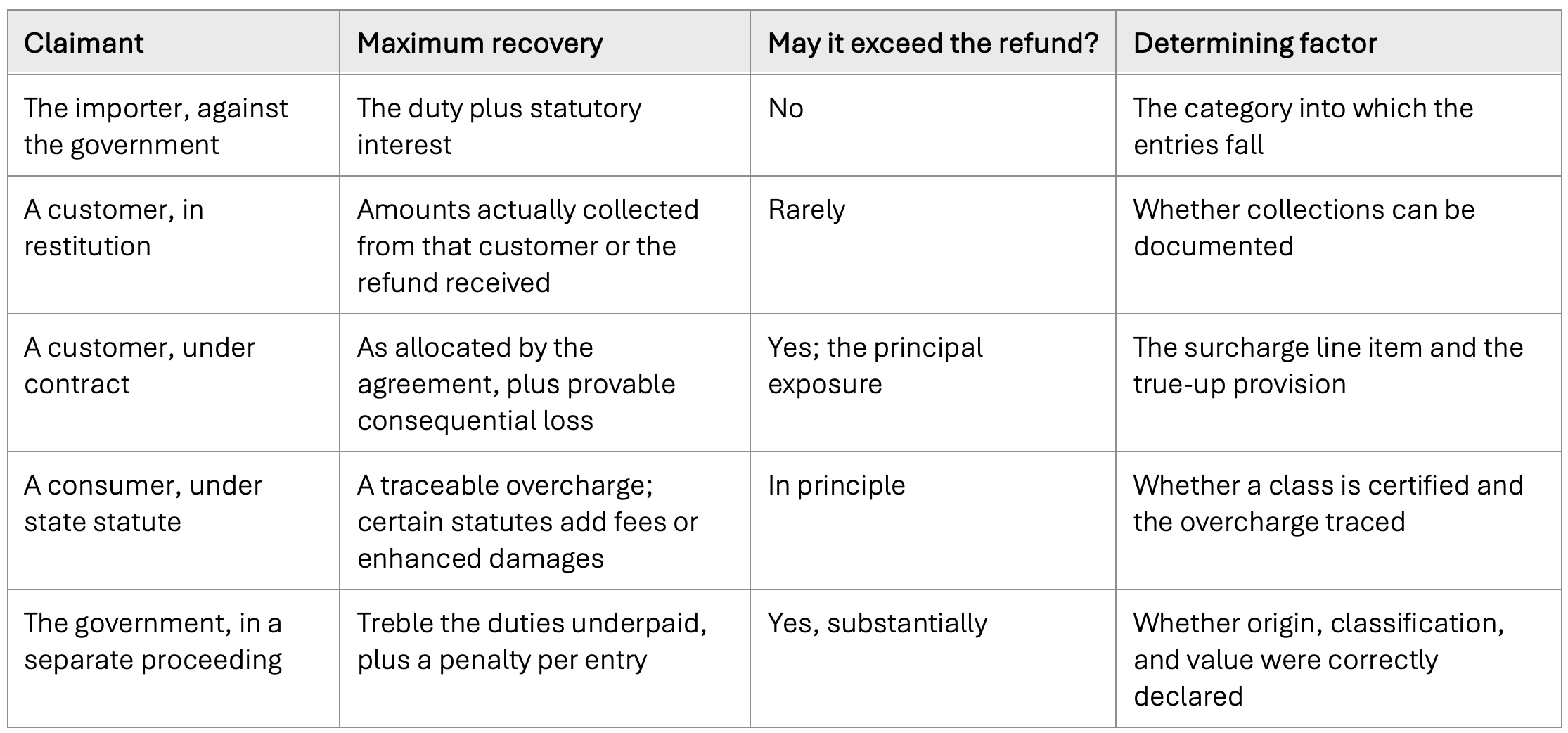
Payment by CBP does not settle a company’s position with its customers. Roughly one hundred proposed consumer class actions have been filed, and large buyers are pressing for a share. A claim’s strength turns principally on whether the customer could see the tariff as a discrete charge or whether it was blended into the product cost and/or price.
When the Tariff Was Separately Charged
Where the tariff was a separate line item—on a freight invoice, under a cost-plus agreement, or under a duty-adjustment clause—the customer’s argument is direct: The IEEPA tariff premium was explicit, the customer funded the payment, and the refund returns that money. Only here may a claim exceed the refund if the agreement allocated consequential costs or they were a foreseeable result of breach. That is ordinary contract damages, not the tariff multiplied.
Contractual and Other Defenses
Defenses are substantial. Many agreements allowed a price increase without promising a rebate; silence is not a true-up provision. Unjust enrichment rarely displaces an agreement that allocated duty-change risk. Passing through a duty both sides believed valid is not self-evidently a breach. Until CBP pays, there may be nothing to remit.
When the Tariff Was Embedded in Price
Where the tariff was absorbed into price, the difficulty is evidentiary. Prices vary with promotions, region, product mix, and season, and goods of several origins share one price, so attributing a tariff dollar to a customer is an estimate. As one example, a manufacturer may have incorporated the IEEPA tariffs paid for raw materials into its cost of goods sold in a multitude of permissible ways; and then applying that “artificially” increased cost of goods sold may have been unevenly applied to the price charged for a product based on multiple considerations. For other companies, whether they use the last-in, first-out (LIFO) or first-in, first-out (FIFO) method of accounting may drastically impact the cost of goods sold and, therefore, the potential recovery amount. These are merely two of many accounting complexities that will be the subject of Part III of this series. For these reasons and others, these cases are hard to certify, and defendants have raised further threshold objections.[viii]
Separate Government Enforcement Risk
The final row is the most-often misconstrued. A misdeclaration proceeding is not the refund trebled but a distinct statute applied to the same documents with enforcement rising independently.[i] Because the refund file is the file such a proceeding would examine, entry data should be verified before certification (see Part I).
Implications for Business Planning
- Forecast only Categories A and B. Until a classwide refund order is final, treating Category C as receivable overstates liquidity and may distort covenant calculations.
- Let the calendar govern filing. For Category C entries nearing the two-year mark, weigh the amount at stake against filing cost and value of class membership. Deferral does not preserve the individual option.
- Build the invoice record now. Negotiating position rests on what the company billed and stated at the time. An importer that can quantify each customer’s share stands far stronger.
- Assess each exposure separately. A consolidated figure overstates the aggregate and obscures what needs attention.
- Prioritize contractual counterparties. Claims backed by an itemized invoice and signed agreement are the likeliest to reach the merits and most amenable to early negotiated allocation.
How BRG Can Help
BRG’s Global Trade & Compliance practice helps companies and counsel navigate evolving trade rules, geopolitical uncertainty, supply-chain risk, regulatory scrutiny, and disputes through integrated compliance, economic, financial, and data-driven analysis. In the IEEPA refund context, we help clients reconcile refunds to entry records, quantify pass-through across the distribution chain, assess customs declarations and third-party exposure, support financial reporting, and provide expert analysis and testimony.
[i] 31 USC §§ 3729–3733. The Trade Fraud Task Force reports more than USD 1 billion in recoveries, penalties, forfeitures, and charged losses. Recent settlements include USD 549.5 million (goods misdescribed to avoid duties) and USD 5.15 million (misdeclared country of origin).
The potential exposure depends on who asserts the claim, the legal theory invoked, and whether the claimed amount can be traced to a particular payment or overcharge.
[i] Orders of Judge Richard K. Eaton in the consolidated IEEPA refund litigation, US Court of International Trade (USCIT) (July 2026).
[ii] Freestyle World, Inc. v. US Customs & Border Protection, Ct. No. 26-01088, Court of International Trade (October 8, 2026), certifying a class under USCIT Rule 23(b)(2). The court estimated that approximately $30 billion in duties would otherwise remain on deposit.
[iii] V.O.S. Selections, Inc. v. United States, No. 26-1895 (Federal Circuit). The government relies on Trump v. CASA, Inc., 606 US 831 (2025).
[iv] 28 USC §§ 1581(i), 2636(i); executive order (EO) 14195; EO 14257. Interest under 19 USC § 1505 accrues through reliquidation. A minority view runs the period from the Supreme Court’s February 20, 2026, decision in Learning Resources v. Trump; the deposit-date measure is the conservative assumption.
[v] Interest accrues from the date of deposit until CBP liquidates or reliquidates the entry, at rates the Internal Revenue Service (IRS) sets each quarter.
[vi] Statutory interest accrues at the IRS overpayment rate, which is reset each quarter. Since January 2025 it has been 7 percent a year for most importers and 6 percent for corporations, apart from one percentage point lower in the second quarter of 2026. On that basis, for duties deposited between February and April 2025, accrued interest typically adds roughly 7 to 13 percent to the duty refunded, depending on the importer’s status, the deposit date, and when CBP reliquidates the entry. See 19 USC § 1505(c); 26 USC § 6621; CBP, “Quarterly IRS Interest Rates Used in Calculating Interest on Overdue Accounts and Refunds of Customs Duties,” 91 FR (September 22, 2026).
[vii] Reported prices rose from roughly 20 cents on the dollar before the Supreme Court’s decision to 80 cents or more by late April 2026. Because 31 USC § 3727 generally bars assigning unallowed claims against the United States, these deals have generally been structured as contractual interests or secured loans.
[viii] Reported defenses include standing, ripeness, voluntary payment, displacement by express contract, and arbitration clauses and class waivers.
Authors



Related Industries



Prepare for what's next.
ThinkSet magazine, a BRG publication, provides nuanced, multifaceted thinking and expert guidance that help today’s business leaders adopt a more strategic, long-term mindset to prepare for what’s next.