The $10 Billion Question: What Do Banks Need to Build Before They Cross the Threshold?

Several bank rules change at or around $10 billion, but the harder transition is organizational. Governance, credit, capital, liquidity, and people must scale before the balance sheet does.
As your bank approaches $10 billion in assets, you may view the upcoming threshold as a straightforward institutional milestone. Less visible is the level of enterprise-wide preparation needed to cross that threshold smoothly.
At the end of Q1 2026, 892 Federal Deposit Insurance Corporation-insured institutions held between $1 billion and $10 billion in assets. This is a substantial population of banks whose continued growth could bring more complex regulatory and supervisory expectations into focus. Although asset size requirements vary based on measurement dates, legal entities, and transition provisions, $10 billion remains an important dividing line. This threshold affects Federal Reserve supervisory treatment, capital requirements, stress-testing expectations, Consumer Financial Protection Bureau oversight, and debit-card interchange economics, among other areas.
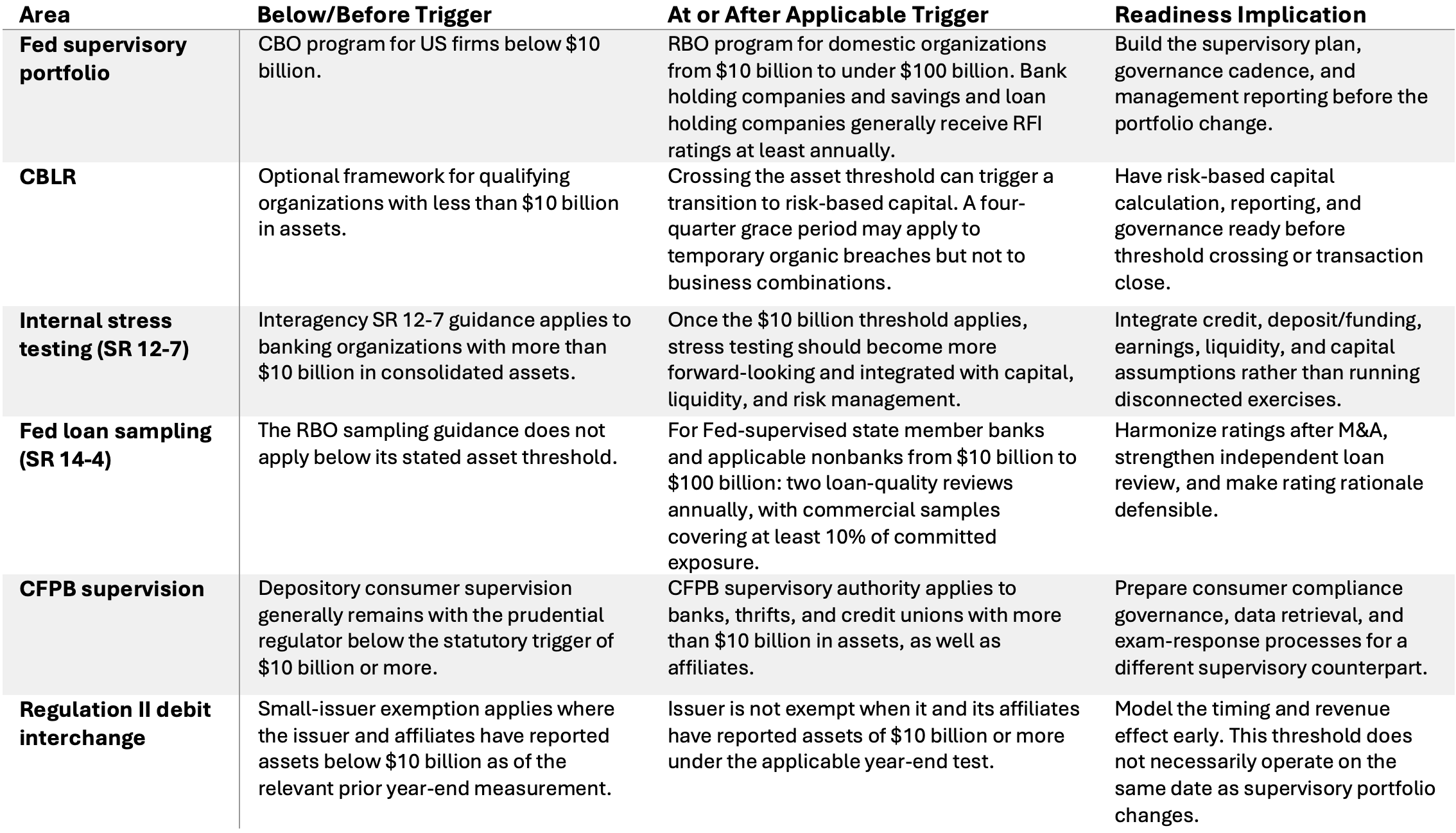
For organizations supervised under the Federal Reserve, the threshold separates the community banking organization (CBO) and regional banking organization (RBO) portfolios. Holding companies between $10 billion and $100 billion generally receive RFI (risk management, financial condition, and impact) ratings at least annually. Organizations with more than $10 billion are covered by the interagency stress-testing guidance in SR 12-7. The CFPB has supervisory authority over banks with more than $10 billion in assets and Regulation II uses another $10 billion test for the debit-card interchange small-issuer exemption.
What the Latest Supervisory Data Says
The Federal Reserve’s June 2026 Supervision and Regulation Report reported 154 outstanding matters requiring (immediate) attention across 98 RBO firms at year-end 2025. The most common matters involved information technology (IT), cybersecurity, and operational risk, followed by management, risk management and internal controls, credit risk, Bank Secrecy Act/anti-money laundering (BSA/AML) issues, asset and wealth management, and market/liquidity risk.
The report also mentions that bank supervisors will continue to focus on commercial real estate lending due to its continued above-average delinquencies, as well as on underwriting practices, loan modifications, loan classifications, and credit loss reserves across CBOs and RBOs.
This is relevant for banks approaching the threshold, as the supervisory focus will extend past the growth itself to how the bank is managing that growth through its credit practices, risk management, underwriting, and internal controls.
The Wealth Effect and Growth Engine
US household and nonprofit net worth increased by more than $67 trillion between 2019 and 2025, the largest six-year increase in nominal household wealth in the Federal Reserve’s historical series. The Fed’s Survey of Consumer Finances also found that real median net worth rose 37% between 2019 and 2022, the largest three-year increase in the survey’s history. That surge in household wealth helped support deposit growth, loan demand, and balance sheet expansion across many community banks.
As balance sheets grew, many institutions began approaching $10 billion in assets through mergers and acquisitions (M&A). There were a reported 127 deals among community banks specifically, up 46% from the year prior. Acquisition-driven growth creates a particular challenge for banks approaching $10 billion. A bank crossing the threshold through a merger does not receive the Community Bank Leverage Ratio (CBLR) grace period and must be ready to operate under the full risk-based capital framework. Capital can be raised or reallocated relatively quickly, but it takes much longer to build a successful operation of people, systems, governance, and expertise for the next level.
The Talent Gap Nobody Is Talking About
As your bank grows, risks once managed separately will begin to overlap. Regulators will expect more robust oversight and controls, while management and the board need a clearer view of how pieces fit together. An acquisition can expose issues quickly. An acquiring bank often keeps its own leadership team and continues with its usual processes. This potentially creates a gap between identifying whether the acquiring bank’s initial teams and processes are the right fit for the larger institution or whether the acquired bank brings experience or practices that should be carried forward.
For asset and liability management (ALM), internal protocols for quick identification of risk impacts become increasingly important, deepening the need for internal competency on the bank’s specific risk vulnerabilities and how they relate to risk modeling, assumptions, and stress testing. Credit teams may understand current concentrations but may struggle to show how those exposures would perform under stress and what resulting losses would mean for earnings and capital. Finance and asset-liability committees may run interest rate, liquidity, and capital exercises separately without understanding the holistic intersection of risks. Board reporting may show that the bank is within its limits without showing stressed headroom, management triggers, or the actions that would follow if conditions deteriorated.
This does not necessarily mean that the bank has the wrong people; the institutional profile has simply become more complex and enhanced capabilities are needed to run it effectively. The time to identify these gaps is before the bank reaches $10 billion, not after.
Where Readiness Work Often Gets Difficult
Governance
Risk reporting at a smaller bank is simpler and built around individual functions or committees. That can be enough when senior management and the board are close to the business and can connect to the issues themselves. But as the bank grows, credit, liquidity, capital, and other risks overlap in ways that are not always obvious when reported separately.
Take a construction concentration that is still below its formal limit. If credit losses begin to reduce capital, the concentration ratio can move higher even if the bank makes no new loans. A point-in-time report may look acceptable while the bank’s actual room for error is shrinking.
Board reporting should make that visible. Directors need to see where the bank stands today, how those positions could change under stress, what would trigger management action, and what those actions would be. Committees can continue to operate separately, but the board needs an additional perspective bringing the risks together.
Credit
As a bank grows, its credit risk grading framework tends to come under closer scrutiny. Practices that worked at a smaller institution may be tested more rigorously once the bank moves into regional bank supervision. M&A can make those weaknesses visible: two banks may both use the term “risk grade 4” while meaning two very different things. The acquired portfolio must be mapped to a common methodology, with loans re-rated where necessary.
For Federal Reserve–supervised state member banks in the regional-bank portfolio, SR 14-4 calls for at least two loan-quality reviews during the annual supervisory cycle, with sampled commercial segments generally covering at least 10% of committed exposure. But 10% is only the starting point. Examiners can expand the sample when growth is rapid and concentrations are high or if they lose confidence in the bank’s internal risk ratings.
That change in approach can catch a growing bank off guard. A grading framework that worked for years under the community-bank supervisory model may receive closer scrutiny once the institution moves into the regional-bank portfolio and a new supervisory team begins testing the ratings. The bank needs clear definitions, consistent application, strong documentation, and enough independent review to explain not just how a rating was assigned but to justify that it is the right rating.
Capital, Liquidity, and Stress Testing
It can be easy to misunderstand the $10 billion stress-testing change. SR 12-7 does not put a regional bank into the Federal Reserve’s public supervisory stress test used for larger institutions. The change is in how stress testing is expected to be used inside the bank. Scenarios should reflect the bank’s actual vulnerabilities, be internally consistent, and account for how one risk can amplify another.
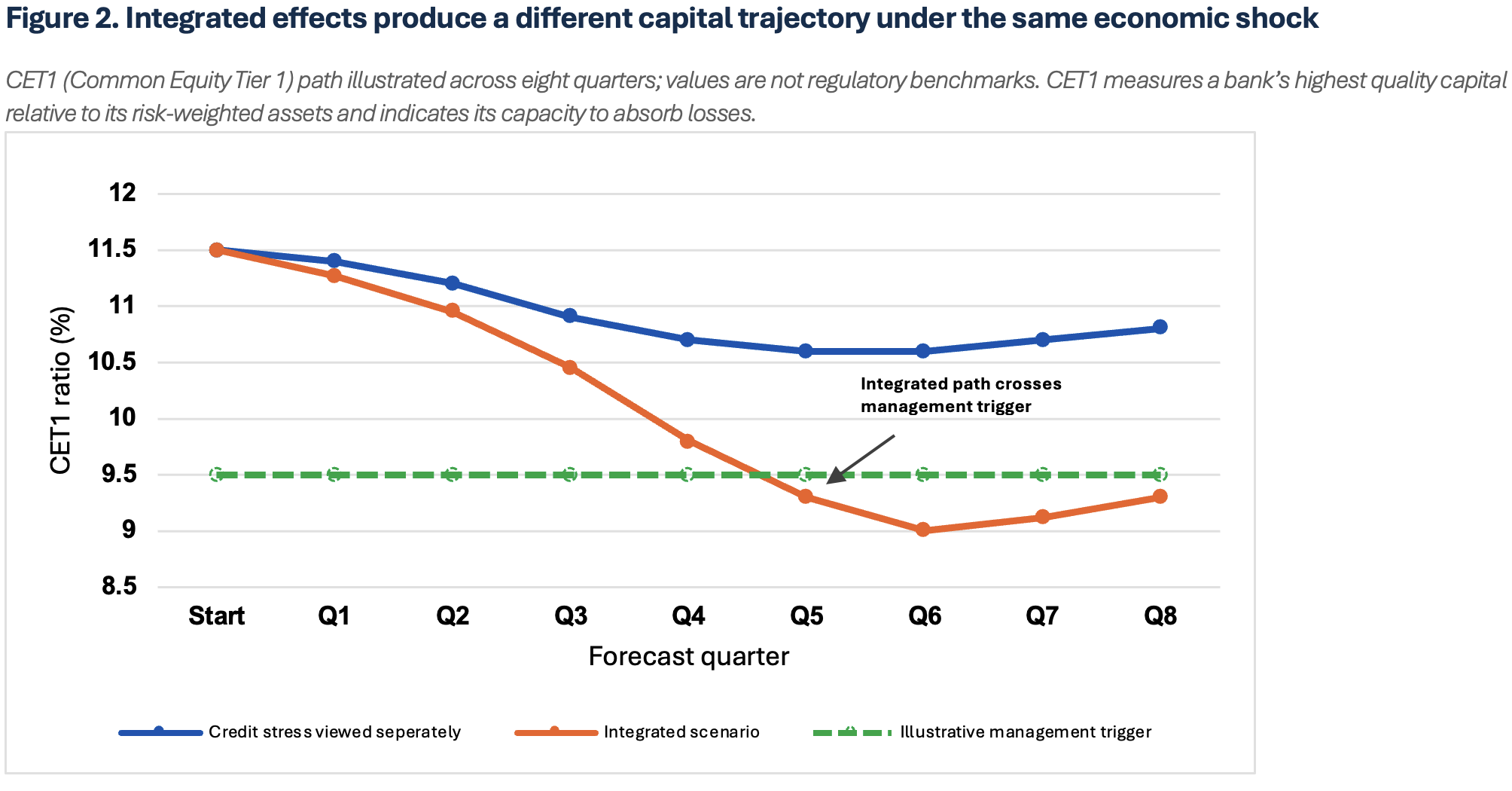
Separate exercises can give management false comfort. A credit stress scenario may assume the bank’s funding profile remains intact. A liquidity test may assume earnings and capital follow the base case. An ALM shock may leave credit performance unchanged. Each result can look manageable on its own. But under the same economic scenario, credit migration can increase provisions, deposit runoff can drive up funding costs, weaker margins can reduce earnings, and lower earnings can put additional pressure on capital. The question is: what happens to the bank when those effects happen all at once and build over time?
The bank’s limitations become clearer when considering what each standalone exercise may effectively hold constant while stressing something else.
Figure 1. What separate stress tests can miss
| Standalone test | What is not captured |
| Credit stress | Deposits and funding costs |
| Liquidity stress | Credit losses, earnings, and capital |
| ALM/Interest rate risk stress | Credit migration and deposit runoff |
Each test may remain within limits even though the assumptions are inconsistent with the same economic event. But each test can assume pressure will show up somewhere else. A credit stress that holds deposits and funding costs constant can leave the capital path looking manageable. Once that same credit deterioration is paired with deposit runoff and more expensive replacement funding, earnings weaken faster and capital can fall through a management trigger. The difference becomes much clearer when the results are carried forward over several quarters.
Governance, credit, capital, and liquidity are not the entire $10 billion readiness agenda. Technology, cybersecurity, compliance, third-party risk, internal audit, issue management, and exam readiness also need to keep pace. It is these areas that often reveal whether the bank is truly operating like a larger and more complex institution.
The Transition Starts Before $10 Billion
A planning horizon of eighteen to twenty-four months is reasonable, though not required, for many banks. The institution should start the process with an assessment of its current capabilities against supervisory expectations that will apply once it exceeds $10 billion in assets. The assessment should extend beyond the three areas discussed above; Federal Reserve supervisory data continues to highlight technology, cybersecurity, operational risk, and internal controls as recurring areas of concern. By the time the Call Report places the bank above $10 billion, the bank’s operating model should already reflect the institution it has become.
Key Changes at the $10 Billion Threshold
If these challenges resonate with what you are seeing in your institution, we welcome the opportunity to continue the conversation.
Related Professionals



Prepare for what's next.
ThinkSet magazine, a BRG publication, provides nuanced, multifaceted thinking and expert guidance that help today’s business leaders adopt a more strategic, long-term mindset to prepare for what’s next.