Beyond Compensation: Quantifying Future Benefits in the CPO Cost-Benefit Analysis

Introduction
The economics of certification has become an increasingly important aspect of the United Kingdom’s (UK) collective actions regime. The UK Competition Appeal Tribunal (CAT or the “Tribunal”) is required to consider whether an application for a collective proceedings order (CPO) meets the “suitability” criterion, including by taking account of “the costs and the benefits of continuing the collective proceedings”.[1] Since the recent Waterside certification judgment,[2] the CAT has placed greater emphasis on the cost-benefit analysis of a claim, particularly where substantial litigation budgets are set against modest individual losses and uncertainty about whether damages ultimately will reach class members.[3]
The CAT now regularly expects proposed class representatives (PCRs) to assess a claim’s costs and benefits as part of the CPO application.[4] The comparison is typically between the (i) expected cost of the litigation and (ii) redress expected to reach the class (that is, the damages suffered adjusted where appropriate for the prospect of success of the litigation and share of any award likely to be distributed to class members).
Commenting on the Waterside judgment, Sir Peter Roth, a former CAT president, noted “the collective actions regime was not set up to operate for the benefit of lawyers, funders and experts… [if] the money was not distributed to class members, one could fairly ask, ‘well, what was this all for?’”[5]
But competition litigation may have a second function in addition to redress. By imposing liability, exposing misconduct and changing the incentives of potential abusers, competition litigation also may end ongoing harm and deter future infringements.[6] This raises the question of whether the benefits assessment should account for not only the remedy of loss suffered but also future harm avoided by ending ongoing conduct or deterring future abuses. In JLP A&A v Apple and Amazon, the CAT recognised that the future benefit of an injunction may be a “further and very relevant matter” to the cost-benefit analysis.[7]
How can these future benefits, whose magnitude and beneficiaries may be uncertain, be assessed in the cost-benefit analysis at the CPO stage? This article suggests a way in which prospective benefits could be considered explicitly in the CAT’s analysis, how they might be quantified and potential analytical pitfalls and evidential burdens.
II Why future benefits may matter at certification
Rule 79(2) of the CAT Rules 2015 provides that, in determining whether claims are suitable for collective proceedings, the Tribunal must take into account “the costs and the benefits of continuing the collective proceedings”.[8] This does not expressly limit the assessment of “benefits” to the quantum of damages ultimately distributed to class members. Equally, it does not explicitly require consideration of prospective benefits from ending the conduct (if it is still ongoing at the time of litigation) through an injunction or preventing future harm by deterring similar conduct.
A CPO is a mechanism to pursue claims collectively and not itself a remedy. Claims pursued in collective proceedings may include those for damages and injunctive relief. Damages principally compensate class members for the loss caused by an infringement, whereas an injunction may generate a separate prospective benefit by bringing ongoing conduct to an end. The question is whether, and if so how, that prospective benefit should be reflected in the Rule 79(2) cost-benefit assessment.
The UK collective proceedings regime has more than one policy objective.[9] In Evans v Barclays Bank, the UK Supreme Court expressly identified “deterring future wrongdoers” as one of the “competing policy aims” underpinning the collective proceedings regime, along with “protecting businesses from the burden of defending unmeritorious or inflated claims”.[10] In JLP A&A v Apple and Others, the Tribunal explicitly stated it was “also conscious of the wider implications of this litigation. The Agreements remain in force, and it is in principle appropriate that their legitimacy should be examined.” In relation to the claimant’s proposed injunction, the Tribunal considered this was “not a decisive factor in our assessment, but it is a further and very relevant matter to take into account in the cost-benefit analysis” (emphasis added).[11] The Tribunal therefore explicitly recognised the wider implications of the litigation and treated the proposed injunction as a relevant consideration in assessing costs and benefits. It did not, however, attempt to quantify that benefit, estimate the future harm avoided or distinguish the direct effect of an injunction from the wider deterrent effect of collective proceedings.
Compensation and deterrence can be complementary objectives. A damages award may both compensate losses and alter the incentives of the defendant and other firms. Injunctive relief imposed by the CAT may also end an ongoing abuse directly. Both mechanisms can contribute to the protection of competition and benefit of claimants. The question is whether, when applying Rule 79(2), the Tribunal should consider credible evidence that the proposed collective proceedings may prevent future anticompetitive harm in addition to assessing the likely compensatory redress to the class.
III Whose benefit counts?
Before estimating any prospective benefit, one should first specify whose benefit counts. The narrowest case is the benefit to class members, for example, where the same claimants who suffered harm are likely to continue purchasing the affected product and would benefit if the conduct ended. Past and future beneficiaries of a litigation also may differ. A consumer who bought the product during the claim period may never purchase it again. Conversely, a future purchaser who benefits from the conduct ending may not fall within the class. Any estimate of benefits to the class therefore would need to reflect the degree of overlap between the class and those likely to benefit in the future.
Wider benefits to future consumers, other firms or the wider economy also may be economically significant. Their relevance to the certification of a particular claim is less straightforward, however, because the cost-benefit analysis of the specific proceedings at hand is not an unrestricted social welfare analysis.[12]
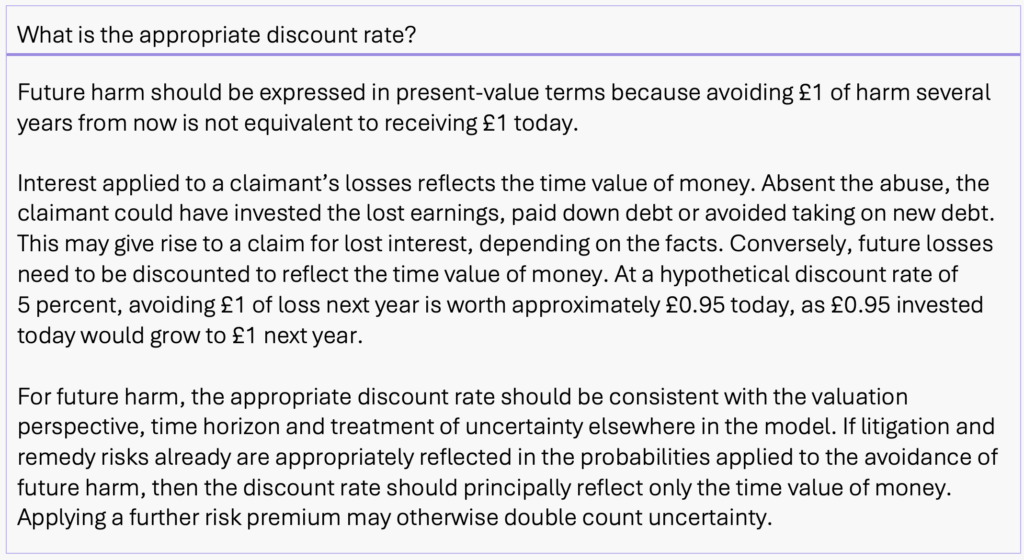
There are therefore two separate questions. The first is a legal one: which future benefits are relevant to the Rule 79(2) assessment (which is not asking whether a litigation is socially desirable but whether a claim should proceed collectively)? The second is an economic one: can future benefits be identified and estimated on a credible evidential basis? This article principally addresses the second question. It does not assume that every benefit of collective proceedings necessarily falls within Rule 79(2).
IV A framework for quantifying future benefits
IV.A Benefits from ending ongoing conduct
If a claim ends ongoing conduct, how might claimants quantify the future harm avoided in addition to the compensation received for losses suffered by the class to date? Consider first the future harm that class members could avoid if a claim ends an ongoing abuse. This is the effect of the specific proceedings on the defendant’s conduct in relevant markets.
The benefit to the class can be decomposed into the (i) redress from a damages award or settlement distributed to class members and (ii) future harm avoided by ending the ongoing conduct.
Damages are calculated by estimating losses suffered over the claim period relative to the counterfactual (that is, what would have happened absent the alleged conduct) and applying an appropriate interest rate. The expected redress is then equal to the estimated damages adjusted for the share that is likely to reach class members.
Let:
- Lt denote the estimated loss suffered by the class due to the conduct in a previous period t;
- st denote the expected share of estimated loss ultimately received by class members, reflecting litigation outcomes and distribution;
- r denote the interest rate;
- t denote the number of years that passed since the relevant loss was suffered; and
- TR denote the number of years since the beginning of the relevant period of the conduct.
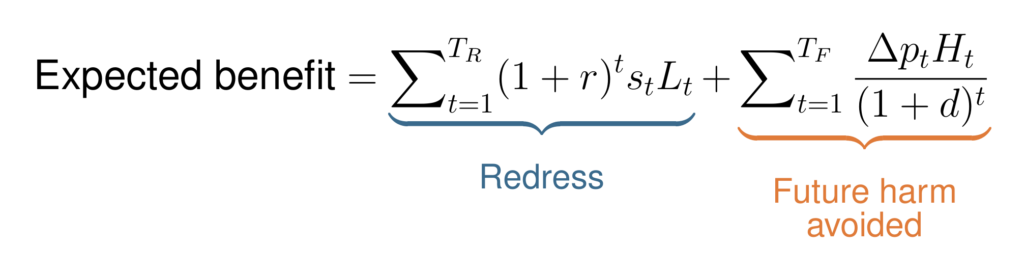
The redress that is expected to reach class members then can be expressed as:

The debate over the accuracy of the estimated redress in a cost-benefit analysis often focuses on the share st of estimated damages likely to be distributed to class members. This can be further decomposed into the:
- probability of obtaining a liability finding, remedy or settlement;
- likely award or settlement as a share of the estimated loss suffered; and
- proportion of the award or settlement likely to reach class members, reflecting any distribution costs or friction.
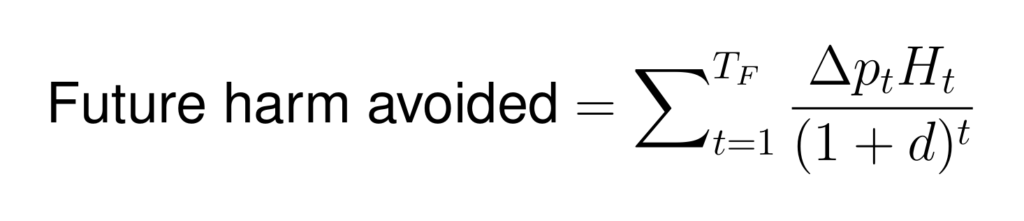
In theory, future harm avoided can be estimated similarly by summing up the harm expected in future years and applying an appropriate discount rate. The relevant counterfactual question is: how much lower is expected future harm if these proceedings continue than if they do not? This should reflect other enforcement and market developments, the timing and effectiveness of any change in conduct and class members’ future exposure to harm. For simplicity, the avoided harm can be estimated by multiplying the expected harm by the proportionate reduction resulting from continuation of the proceedings. This reduction may reflect changes in the probability, extent or severity of conduct.
Let:
- Ht denote the expected harm that would be suffered by the class in period t if the proceedings did not continue;
- △pt denote, in reduced form, the proportionate reduction in the expected harm attributable to continuation of the proceedings;
- d denote the discount rate;
- t denote the number of years until the relevant harm would occur; and
- TF denote the number of years until the end of the relevant time horizon.
The expected present value of future harm avoided then can be expressed as:
The main difficulty in estimating the future benefit likely lies in assessing the extent to which a reduction in future harm results from the specific proceedings (that is, △pt). Relevant considerations in assessing this reduction include the:
- probability that the conduct would occur in any event, absent the proceedings;
- probability of an outcome capable of changing the conduct, including a liability finding, settlement commitments or voluntary change; and
- extent to which any change in conduct results directly from these proceedings.
This is deliberately a simplified representation, and the specific factors to consider will depend on the facts of the case and available evidence. A more detailed analysis might need to distinguish between changes in the (i) probability and (ii) severity of harm or between different possible outcomes of the proceedings.[13] For example, rather than considering only whether the claim ultimately succeeds, one could construct a “scenario tree” allowing for different pathways such as a voluntary change in conduct prompted by the proceedings. The simplified framework presented here does not attempt this. Nor does it imply that future benefits should necessarily be estimated with greater precision than future costs. The cost-benefit analysis necessarily involves uncertainty on both sides. Just as expected litigation costs typically may be assessed using reasonable assumptions about the future course of proceedings, future benefits may be appropriately assessed using reasonable assumptions about harm and the course of the proceedings.
The expected benefit of the litigation can then be expressed as the sum of the (i) redress for loss suffered that reaches class members plus (ii) future harm avoided. Unlike a damages distribution, avoiding future harm does not require class members to submit a claim and avoids any frictions from distribution.
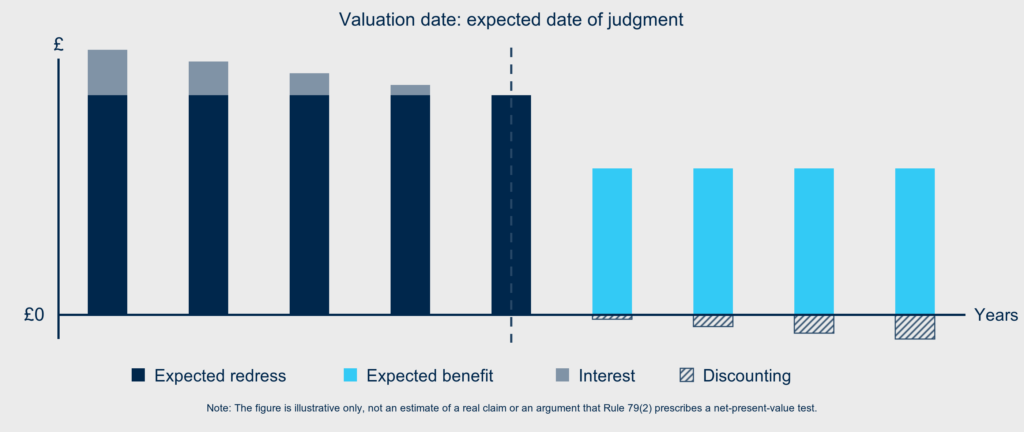
Redress and future harm avoided should be defined consistently with the timing of the litigation so that the same loss is not counted twice. The relevant distinction is between harm that actually occurs and may subsequently be compensated; versus harm that is avoided because the proceedings change future conduct. Harm may continue to arise while proceedings are ongoing and subsequently form part of the damages claim. Conversely, harm that is avoided because the proceedings change future conduct cannot also give rise to redress. For simplicity, this framework values both components at the assumed date of judgment:[14] losses forming part of the redress are brought forward to that date, while harm expected to be avoided thereafter is discounted back to the same date. If costs and benefits instead are valued at an earlier date, such as the certification hearing, all components should be expressed consistently at that common valuation date.
Figure 1. Timeline of redress and future benefits valued at date of judgment
IV.B Comparing costs and benefits on a consistent basis
The total expected benefits then can be compared against the relevant costs of continuing the proceedings. This comparison should be made on a consistent basis: redress, future benefits and costs all should be valued at the same date (for example, the expected date of judgment). Where the question is whether the proceedings should continue, the economically relevant costs are in principle the expected costs that remain to be incurred, rather than costs that are already irrecoverably sunk. However, previously incurred costs remain relevant where they are expected to be deducted from any damages ultimately distributed to the class. Care should be taken to ensure consistency between the two sides of the comparison. For example, funding or distribution costs which already have been reflected in the expected amount ultimately distributed to the class should not simply be included again in the cost comparator. More generally, the analysis should identify clearly which costs are included, where they enter the calculation and why.
IV.C Wider deterrence and the risk of double counting
Next, consider the deterrent effects beyond the defendant and specific abuse addressed by the proceedings. A successful claim but also deter future conduct by other firms. Third parties that observe the litigation may conclude that similar conduct carries a greater risk of financial consequences and change their behaviour accordingly. The class may benefit from this deterrent effect if it shields class members from similar conduct by other firms.
The same avoided harm should not be double counted if both an injunction and deterrence contributed to preventing it. Even after the specific conduct has ended, a collective claim may reduce recurrence by the defendant or discourage similar conduct by other firms. Conversely, an injunction may directly prohibit the specific conduct without generating wider deterrent signals to other market participants, for example, if other firms already comply. The mechanisms of an injunction and deterrence are therefore related but not interchangeable.
Wider deterrence is more difficult to attribute to specific proceedings, in particular if several collective actions concern similar conduct or industries. For example, a successful excessive-pricing claim concerning one app store might influence commission levels on other digital stores. But the relevant benefit is not measured by every subsequent reduction in commission across the economy. The assessment needs to consider which firms are likely to observe and respond to the proceedings, how much of any behavioural change results directly from the specific proceedings rather than public enforcement, regulation or market developments and whether the beneficiaries fall within the class.[15]
Where several proceedings may contribute to the same change in conduct, the relevant question for each proceeding is its marginal contribution: how would future harm differ if that proceeding did not continue, given appropriate assumptions about the continuation and effect of other proceedings or enforcement actions? The aggregate deterrent effect between several proceedings should not simply be apportioned among them. The marginal contribution may be small or zero if another existing proceeding would independently produce the same outcome. Conversely, where several proceedings are jointly necessary to bring about a change in conduct, removing any one of them could eliminate much or all of the expected benefit. The marginal contributions of each individual proceeding therefore need not sum to the aggregate benefit collectively generated by the proceedings.
The benefits analysis could also consider whether class members would benefit from conduct ending in other markets (for example, members of a large class of app store users also may use other digital stores on which commissions might fall due to the deterrent effect). Even then, only the effect attributable to the particular proceedings should be counted. Nor should the deterrent effect of a collective damages claim be assumed to be identical to that of a public enforcement decision or an injunction. The visibility of the proceedings, likelihood of liability, financial consequences, nature of the conduct and enforceability of any remedy all matter.
V Challenges and opportunities
V.A Evidentiary challenges
The principal difficulties are evidential rather than mathematical. How reliable is the estimate of harm? What supports the assumed probability that the conduct will continue or recur? Would the defendant’s future conduct change in any event, for example because of market entry, public enforcement or other developments such as technological progress? How quickly would a change occur, and how long would it last?[16]
A credible assessment would require case-specific evidence, potentially including the expected duration and persistence of the alleged conduct, market data, the defendant’s incentives, internal or public statements about future conduct, comparable enforcement experience and the likely effect of the proposed remedy. Any assessment of future benefits should also be proportionate. The purpose at certification likely would be to determine whether a credible evidential basis exists for treating future harm avoided as a material benefit of the litigation, not to establish the precise deterrent effect. If certification turns on the issue, however, assumptions about future benefits may become contested.
If there is no reliable basis for estimating the counterfactual, the appropriate conclusion may be that the prospective benefit cannot be quantified with sufficient confidence. Recognising deterrence as a potential benefit should not become a licence to assign speculative value to the proceedings. In many cases, a range of potential benefits may be more informative than a point estimate.
The CAT may wish to consider how large the attributable reduction in future harm would need to be to materially change the result of the cost-benefit exercise; and whether that threshold is plausible on the available evidence.
V.B Benefits without a claims process
In Waterside, the Tribunal’s primary concern was that the PCR had not established a sufficient evidential basis for expecting the likely benefits to the class to be proportionate to the costs. Claims concerning a large class and substantial aggregate alleged harm may still face a difficult certification question if the expected amount reaching class members is low relative to the proposed costs. The Tribunal also referred to the low take-up rate of the settlement in Gutmann v First MTR South Western Trains.[17]
A benefit from avoiding future harm does not require class members to submit a claim or engage with a distribution process. If the proceedings end or prevent the relevant conduct, consumers who remain exposed to the market may benefit without taking any further action. That does not make the benefit certain, however. It still depends on (i) the proceedings changing the defendant or other firms’ behaviour, (ii) the conduct continuing absent the proceedings and (iii) class members remaining exposed to the resulting harm. Unlike a damages payment, however, the benefit is not reduced by low participation in a claims process.
The direct prospective benefit may be less important where the alleged conduct has already ended. That was the position in Waterside, for example, where the alleged conduct ended in 2019. In such a case, the argument for future benefits would rest principally on the prevention of recurrence or wider deterrence. Those effects still may be relevant but harder to attribute to the continuation of the particular proceedings.
VI Concluding thoughts
Compensation for harm suffered is not necessarily the only economic benefit of competition litigation. Proceedings also may change incentives and prevent future harm. When the CAT asks whether the benefits of collective proceedings justify their costs, it may wish to consider not only the compensation likely to reach the class for harm suffered but also a credible, evidence-based estimate of future harm that the proceedings may prevent.
A carefully evidenced assessment of future benefits would not remove the need to scrutinise litigation budgets, distribution arrangements or the merits of the proposed proceedings. However, if avoiding future harm is an objective of the collective proceedings regime, the question of how these benefits can be measured deserves further consideration. The proposition is not that speculative value of deterrence should rescue an otherwise uneconomic claim or that prospective benefits invariably must outweigh the costs of litigation. From an economic perspective, a cost-benefit test at least should recognise that there may be material benefits beyond compensation and formalise the analysis of those benefits and the main factors that affect their potential value.
[1] Competition Appeal Tribunal Rules 2015, Rule 79(2).
[2] In Waterside, the Tribunal refused to grant a CPO on the proposals before it, concluding that the PCR had not demonstrated that the likely benefits to the class would be proportionate to the substantial costs of the litigation; and invited the PCR to reformulate the cost-benefit assessment. Waterside Class Limited v Mowi ASA and others [2026] CAT 32, para. 61–62.
[3] The UK Department for Business and Trade’s 2026 consultation also proposes giving greater weight to cost-benefit considerations and likely take-up by class members. Department for Business and Trade, Swifter and Simpler Competition Redress, Regulatory Appeals, and Competition Enforcement (July 2026), para. 29.
[4] Lo, Matthew, “Waterside: Is the CAT’s Cost-Benefit Approach Squeezing the Life Out of Smaller Collective Actions?”, Kluwer Competition Law Blog (4 May 2026).
[5] Rothwell, Rachel, “In depth: CAT ready to get tough on ‘entrepreneurial’ class actions”, The Law Gazette (18 May 2026).
[6] Ioannidou, Maria, “UK Collective Actions against Big Tech: private enforcement 2.0?”, Journal of Antitrust Enforcement (2026), pp. 4–5; Flint Global, Collective Proceedings in the UK (April 2026), pp. 30–38.
[7] JLP A&A Class Representative Limited v Apple Inc and Others [2026] CAT 75 (28 September 2026), paras. 179 and 283–284.
[8] From an economic perspective, the Rule 79(2) cost-benefit analysis should be distinguished from a social-welfare analysis. Expected redress is principally a transfer between the defendant and those harmed and should not necessarily be treated as a net social welfare gain.
[9] UK Department for Business, Innovation & Skills, Private Actions in Competition Law: A Consultation on Options for Reform (April 2012), stating that “collective actions may be an important mechanism for providing access to justice for the claimant, as well as of increasing deterrence through tackling anti-competitive behaviour that the public authority has not addressed”.
[10] The judgment concerned opt-in versus opt-out proceedings under Rule 79(3), not monetisation of deterrence under Rule 79(2). Evans v Barclays Bank plc [2025] UKSC 48 (18 December 2025), para. 137.
[11] JLP A&A Class Representative Limited v Apple Inc and Others (2026), paras. 179 and 283–284.
[12] See also the discussion of double counting benefits in Section IV.C.
[13] In practice, the different factors affecting the probability and extent of harm may not be independent. A more detailed analysis may need to model them jointly, assigning conditional probabilities and different levels of harm to each possible outcome of the proceedings. The reduced-form expression summarises the resulting difference in expected harm but does not suggest that these are multiplicative independent factors.
[14] This assumes for simplicity that the date of judgment coincides with the resulting change in conduct and redress reaching class members. Any expected delay in distribution could in principle be reflected in the redress valuation.
[15] For a discussion and estimates of the wider economic benefits of the UK collective proceedings regime, see: Stephenson Harwood, Realising the Benefits of Competitive Markets: Strengthening the Competition Appeal Tribunal (October 2025), pp. 30–32; and Flint Global (2026), pp. 16–18, 30–38. This article addresses a narrower question, namely how future benefits attributable to the continuation of a specific collective action might be assessed for the purposes of the cost-benefit analysis at certification.
[16] These difficulties are not specific to collective proceedings. A CMA review of the wider benefits of competition policy and enforcement similarly highlights challenges of measuring the deterrence effect of competition enforcement; CMA, Wider Benefits of Competition Policy and Enforcement, CMA Microeconomics Unit literature review (13 January 2025).
[17] Waterside Class Limited v Mowi ASA and others [2026] CAT 32, paras. 18–20; Gutmann v First MTR South Western Trains Ltd [2025] CAT 72, paras. 65–69.
Related Professionals



Prepare for what's next.
ThinkSet magazine, a BRG publication, provides nuanced, multifaceted thinking and expert guidance that help today’s business leaders adopt a more strategic, long-term mindset to prepare for what’s next.